Best Treadmill
Best Treadmills for Seniors
Step-up height, minimum speed and handrail length — the three numbers that decide it, and which machines publish them.
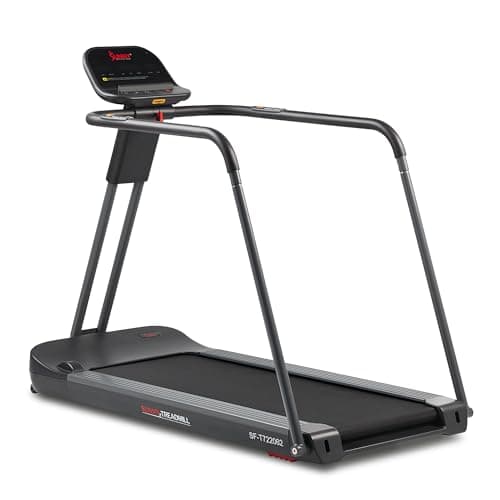
Top pick: Sunny Health & Fitness Treadmill with Extended Safety Handrails, Low Deck
A little incline lets you reach moderate intensity at a slower, safer speed — a real advantage past 60. But it also loads the knees and challenges balance differently, so here’s how to use it well.
The short answer
A gentle incline lets you reach moderate intensity at a slower belt speed, which is safer for an older walker than speeding up. But uphill loads the knees more and challenges balance, so keep the grade small, hold on if you need to, and skip it if a knee objects.
Incline is the most useful button on a treadmill for an older walker, and the most misused. Used well, it solves a genuine problem: how to work hard enough to count without walking fast enough to feel unsafe. Used badly, it stacks a steeper joint load and a trickier balance task on top of each other. The difference is entirely in how gently you start and how patiently you build.
Here is the trade every older walker runs into. To reach a moderate-intensity effort on a flat belt — the level the CDC describes as brisk walking, where you are working but can still hold a conversation — most people have to walk genuinely briskly. And a brisk belt speed is exactly where an older walker is most likely to feel rushed, stiffen up, or struggle to step off cleanly.
Incline is the other lever. Tilt the deck a little and the same slow, controllable belt speed suddenly asks more of you, because now you are walking uphill. You reach the moderate effort you were after without the belt ever moving fast. That is the whole case for it: harder work at a lower, safer speed.
Why the effort matters is not in dispute. The CDC’s guidance for adults 65 and over is at least 150 minutes a week of moderate-intensity activity, plus muscle-strengthening on two days and some balance work. Getting to 150 minutes is much easier when each walk actually reaches a moderate effort, and incline is how you get there without pushing the speed into a range that feels unsteady.
This advantage is bigger the older you are. A slow belt is easier to balance on, easier to judge, and far more forgiving on the day you catch a toe or lose your rhythm. Trading speed for grade keeps the part of walking that gets riskier with age — the pace — low, while still letting the effort climb. That is a good bargain past 60.
The catch is that the same grade that lets you keep the speed down asks more of your knees. Walking uphill means your legs are lifting and pushing your body up with every step, not just carrying it forward, and that extra work lands largely at the knee. A grade that is gentle stays comfortable; a grade that is ambitious is the single most common way a pleasant treadmill walk turns into a sore knee that evening.
None of that means incline is bad for the joint. The Arthritis Foundation is clear that movement generally helps osteoarthritis rather than aggravating it — a joint that keeps moving through a comfortable range tends to do better than one that is rested into stiffness. A gentle incline that keeps you walking regularly is, for most people, on the helpful side of that line.
The word doing the work is gentle. Keep the grade small enough that your knees are not the thing you notice, and judge it the honest way: by how the joint feels the next morning, not by how it feels while you are warm and moving. If a knee objects — not the ordinary stiffness that eases as you warm up, but pain that builds or lingers — lower the grade or drop it to flat, and read our guide on knee pain on a treadmill before you push on. If it keeps happening, that is a conversation for your doctor or a physical therapist, not a setting you should experiment your way through. Nobody here is a clinician.
The second caution is balance. A flat treadmill already asks you to stay steady on a surface that is moving under you. Add a grade and you have changed the ground you are standing on as well — a tilt shifts your posture and your weight forward a little, and your body has to adjust for that on top of everything else. That is two balance tasks running at once.
This matters because falls are not a small risk in this age group. The CDC reports that more than one in four adults aged 65 and over falls each year, and that falling once roughly doubles the chance of falling again. A stumble on an inclined, moving belt is not a gentle one.
The practical answer is simple. Keep a hand on the handrail, or both hands if the grade is new to you, and look ahead at something across the room rather than down at the deck — looking down tips your head and drags your balance forward, which is the last thing you want on a slope. If holding on the whole time is what keeps you steady, hold on the whole time; the goal is walking regularly and safely, not walking hands-free. And if you feel unsteady at even the gentlest grade, that is your signal to come back to flat.
The mistakes with incline are all mistakes of impatience. Start smaller and slower than feels worthwhile, and let your body confirm each step before you take the next.
And because incline raises the demand on your heart as well as your legs, treat the start of an incline habit the way you would treat starting anything new: if you are managing a heart condition, arthritis, a recent fall, or a change in medication, talk to your doctor or physical therapist before you add the grade. That is not a formality — it is the one step this site cannot do for you.
Not every walking machine inclines. Many walking pads are flat by design, and some budget treadmills offer only a fixed manual tilt you have to stop and set by hand rather than a grade you can change mid-walk. If incline is a feature you actually want to use, that is worth knowing before you buy, and our roundup of the best treadmills for seniors flags which machines incline and how. Whatever you choose, full-length handrails matter more here than on a flat belt, for the balance reasons above.
Once you are walking on a grade, the question becomes how hard is hard enough — and here the belt speed stops being a useful guide, because incline lets a slow speed produce a real effort. The honest gauges are how you feel and, if you want a number, your heart rate. A rough check you can do without any device is the talk test: at a moderate effort you should be able to talk but not comfortably sing. If you would rather work to a target, our guide to heart-rate zones for walking walks through how to estimate and read one.
The point of all of it is the same: incline lets you do more without going faster. Use that gently and it is one of the best tools an older walker has. Push it and it quietly becomes two extra risks at once. Keep the grade small, keep a hand near the rail, and let the next morning tell you whether you got it right.
General information, not medical advice. Tread & Tone is written by an enthusiast, not a clinician. Nobody here is a doctor, a physical therapist or a trainer, and nothing on this site has been medically reviewed. Talk to your doctor or physical therapist before starting something new, particularly after surgery, a fall, or a change in medication.
For many people, yes. A gentle grade lets you reach a moderate effort at a slower belt speed, and a slower belt is easier to stay balanced on and safer if you stumble than speeding up to work as hard on the flat. The cautions are real, though: uphill asks more of the knees and shifts your balance forward, so it suits a steady walker better than someone who is unsteady or nursing a sore joint.
Start at the gentlest grade the machine offers — the one you can barely feel — and treat that as plenty for the first few weeks. We are not going to hand you a number, because the right grade depends on your knees, your balance and your fitness, and a figure that suits one person overloads another. The honest rule is: small enough that your gait and breathing stay comfortable, and no steeper until that is true week after week.
It can do either. The Arthritis Foundation is clear that movement generally helps arthritic joints rather than harming them, so a gentle incline that keeps you walking regularly is usually a good thing. But uphill increases the work at the knee, so a steep grade can be the thing that tips a comfortable walk into a sore one. Keep it gentle, judge by how the knee feels the next morning, and see our guide on knee pain on a treadmill if one objects.
For an older walker, often yes. Both raise your effort, but speed does it by making the belt move faster under you, which is harder to stay balanced on and worse if you trip. Incline raises the effort while the belt stays slow and controllable. That trade — more work, same manageable speed — is the main reason incline is worth using past 60.
No. Incline walking is endurance work — it trains your heart and lungs and your legs’ stamina, but it is not the muscle-strengthening the CDC counts separately. Adults 65 and over are advised to do muscle-strengthening on two days a week in addition to their walking, plus some balance work. Incline makes your walking count for more; it does not tick the strength box.
This is one to raise with your doctor or physical therapist before you try it. A grade plus a moving belt is two balance challenges at once, and the CDC reports that more than one in four adults over 65 falls each year. If your balance is already a worry, the safer path is a flat belt with both hands on the rails, and balance work done separately, until someone who can watch you move says otherwise.
Product measurements are cited individually inside each Fit-to-You panel, against the manufacturer page or dated retailer listing they were read from.
Best Treadmill
Step-up height, minimum speed and handrail length — the three numbers that decide it, and which machines publish them.
Top pick: Sunny Health & Fitness Treadmill with Extended Safety Handrails, Low Deck
Most treadmill knee pain traces to three things you can change without buying anything — speed, stride and the deck under you. When it's the machine, and when it's the doctor.
Read the guideWhat 'moderate intensity' actually means as a number, how to estimate your own range, and why the talk test beats a watch for most people.
Read the guide