Chair Exercises for Seniors
Which chair to use — and it matters more than the exercises — followed by a routine that takes twelve minutes.
Read the guideWater takes almost all the weight off your joints while still making your muscles work — one of the gentlest ways to exercise past 60. Here's what you can do in a pool, and the simple gear that helps.
The short answer
Water’s buoyancy carries most of your body weight, so an arthritic knee or hip barely bears a load — yet the water still pushes back on every movement, so your muscles keep working. That makes it one of the gentlest ways to exercise past 60. All you need is a pool and a little simple kit. Never exercise in water alone.
Two things happen at once when you stand in a pool up to your chest, and it is worth keeping them separate, because together they explain why water suits an arthritic joint so well.
First, buoyancy takes the weight off.This is simple physics rather than a health claim: water pushes up on anything in it, and by the time you are submerged to chest height that upward push is carrying most of your body weight. A knee or hip that groans under your full weight on land is barely loaded in the pool. There is no impact, no jarring, and no moment where the joint has to absorb a footfall — you can march, swing a leg, or take a big step, and the water catches you.
Second, the water still makes you work. Buoyancy removes the load, but resistance replaces it with something gentler. Water is far thicker than air, so every movement has to push it out of the way. Walk across the pool and your legs meet steady resistance in both directions; lift an arm and the water resists that too. The faster you move, the harder it pushes back, which means you set the effort yourself, simply by moving faster or slower. Your muscles keep working the whole time, without your joints ever taking a pounding.
That combination — almost no weight-bearing load, but continuous resistance — is why water exercise turns up on the Arthritis Foundation’s list of ways to work out with arthritis, alongside walking and cycling as a low-impact option. And the broader point holds: the Arthritis Foundation is clear that, for an arthritic joint, movement generally helps rather than harms — a joint that is used gently and regularly tends to feel better than one that is rested completely. Water simply lets you move a sore joint with less to fight against than almost anywhere else.
None of that makes water a treatment, and nobody here is a clinician. What it is, is an unusually forgiving place to be active — which, for a lot of people past 60, is exactly the barrier that has been stopping them.
“Water aerobics” sounds like a class with music and an instructor, and it can be that. But on your own, in a community lane or a backyard pool, it is much plainer: a handful of simple movements done in water that reaches somewhere between your waist and your chest. You do not need to swim a stroke, and your head never has to go under.
Water walking is the place to start and the one most people underrate. Simply walk from one side of the shallow end to the other and back, standing tall, letting your arms swing. Because the water resists you, an easy walking pace becomes real, steady work for your legs and hips without any of the impact of walking on pavement. Change direction, walk sideways, or walk backwards for variety once you feel steady.
Standing marches lift the effort a little. Stand in one place, hold the pool edge or a noodle if you want the reassurance, and march on the spot, bringing each knee up toward the surface in turn. The water supports the leg on the way up and resists it on the way down, so both directions do something.
Gentle leg swingsuse the water to move a joint through its range without load. Hold the wall with one hand, then swing the outside leg slowly forward and back, and afterwards out to the side and back. Keep the movements slow and within a comfortable range — the goal is a joint moving freely, not a stretch you have to force.
Arm movements work the upper body against the same resistance. With your shoulders under the water, sweep your arms out to the sides and back in, or push them forward and pull them back. Turn your palms to face the direction you are pushing and the water resists more; slice with the edge of your hand and it resists less. That is your dial.
A sensible session strings a few of these together: some water walking to warm up, a set of marches, some leg swings for each leg, a few minutes of arm work, and a slow walk to finish. Start with what feels like too little. Everything in water feels easy while you are doing it, and it can still be felt the next day.
The honest headline is that you need almost nothing. A pool and your own body are the whole requirement, and water walking needs no equipment at all. A few inexpensive items make things easier or add variety, and every one of them is the kind of thing that costs very little.
A pool noodleis the most useful and the cheapest — a length of buoyant foam. Held under the arms or across the body it gives you something to balance against; tucked under the thighs it can support you for seated-style movements in deeper water. Most people who exercise in a pool own one before anything else.
Foam or “water” dumbbellsare lightweight foam weights that are easy to hold in the air and become resistance tools in the water — because the foam wants to float, pushing it down and moving it through the water is the work. They are not heavy weights and are not meant to be; they add gentle resistance to arm movements.
Aqua shoes— snug shoes with a grippy sole made for water — are worth it for the footing alone. Pool floors are hard and slick, and a shoe that grips takes a real slip risk out of the equation while protecting your feet from rough surfaces.
That is genuinely the list. There is fancier water-exercise equipment for sale, but for the movements above, a noodle, a pair of foam dumbbells if you want them, and grippy shoes cover everything. Do not let a shopping list become the reason you put off starting.
Water is gentle on the joints, but it is still water, and a few rules matter more here than the exercise itself.
Never exercise in water alone. This is the one that is not negotiable. Use a pool with a lifeguard, or have someone with you who can see you the whole time. A dizzy spell or a slip is a different kind of problem in water than on land, and the presence of another person is the single most important safety measure there is.
Get in and out carefully.The steps and the poolside are wet, hard and slippery, and that is where falls happen — not during the exercise. Use the handrail, take the steps one at a time, and never rush the entry or the exit. Grippy aqua shoes help here too.
Warm water, not cold.Cold water tightens muscles and stiff joints, which is the opposite of what you want. A pool that is comfortably warm — the kind often described as a “therapy” or “warm-water” pool — makes movement easier and more pleasant. If a pool leaves you shivering, it is too cold to relax a sore joint in.
Stop if something is wrong. If you feel dizzy, lightheaded, breathless beyond gentle exertion, or any chest discomfort, stop and get out with help. It is easy to overdo it in a pool precisely because it feels so easy while you are in it, and it is easy to forget that you can still get too warm or dehydrated in water.
Talk to your doctor before you start.This is a genuinely new kind of activity for most people, and the sensible order is to ask your doctor or physical therapist first — especially if you have a heart condition, balance problems, any open wounds or infections, or you are recovering from surgery. Nobody at Tread & Tone is a clinician, and this page is about what water does, not about whether it is right for your particular body.
Water exercise counts. The CDC’s guidance for adults 65 and over asks for at least 150 minutes a week of moderate-intensity activity, plus two days of muscle-strengthening work and some balance activity. Steady water walking and standing exercises are a comfortable way to build those aerobic minutes, and the CDC’s explanation of what counts as moderate activity makes clear that anything that gets you moving and a little breathless qualifies — it does not have to be done on land.
But water does not cover everything, and this is where honesty matters. Two gaps in particular:
Balance.Because the water holds you up, a pool is a poor place to train the balance you use on dry land — the whole point is that you cannot fall. Balance is trained by standing, wobbling slightly, and correcting, on solid ground. That work has to happen out of the pool, and it matters, because falls are a serious risk as we age. Our guide to balance exercises for seniors covers the simple, safe versions.
Land-based strength.Foam dumbbells in water are gentle resistance, not real strength training, and buoyancy means your bones and muscles never carry your full weight in the pool. Some weight-bearing and resistance work on land — even seated — still belongs in your week. Our chair exercises guide is a low-risk place to start.
So the honest picture is this: water aerobics is one of the kindest ways there is to get your aerobic activity and to keep an arthritic joint moving, and for many people it is the thing that makes exercise feel possible again. Treat it as the gentle center of your week, not the whole of it, and pair it with a little balance and strength work on land.
General information, not medical advice. Tread & Tone is written by an enthusiast, not a clinician. Nobody here is a doctor, a physical therapist or a trainer, and nothing on this site has been medically reviewed. Talk to your doctor or physical therapist before starting something new, particularly after surgery, a fall, or a change in medication.
Yes, and it is one of the better options. Water exercise appears on the Arthritis Foundation's list of low-impact ways to work out with arthritis, and the Foundation is clear that movement generally helps an arthritic joint rather than harming it. Buoyancy takes almost all the weight off the joint while the water's resistance keeps the muscles working — gentle and genuinely useful at the same time. It is not a treatment, and nobody here is a clinician.
No. Any pool you can stand up in works — a community pool, a gym pool, or a backyard pool. What matters more than the pool is the water depth and temperature: waist-to-chest depth for most of the exercises, and comfortably warm water rather than cold, since cold tightens stiff joints. A warm-water or therapy pool is ideal if you have access to one, but it is not a requirement to begin.
Yes. Water aerobics is done standing in shallow water, usually between waist and chest deep, with your feet on the pool floor and your head well above the surface — you never have to swim or put your face in. Stay in water you can comfortably stand up in, keep near the edge, and never exercise alone. If you are nervous, a pool noodle or the handrail gives you something to hold.
Almost nothing. Water walking needs no equipment at all. Beyond that, three inexpensive items help: a pool noodle for support and balance, foam or water dumbbells that add gentle resistance to arm movements, and grippy aqua shoes for safe footing on slick pool floors. None of it is costly or complicated, and you can start with just a swimsuit and a pair of shoes that grip.
A few times a week is a sensible target. The CDC suggests adults 65 and over aim for at least 150 minutes of moderate activity a week, which water walking and standing exercises can help build toward. Start with shorter sessions two or three times a week and add time slowly — everything in water feels easy while you are doing it and can still be felt the next day, so build up gradually and see how you recover.
Not quite. It is excellent for aerobic activity and for keeping sore joints moving, but there are two things it cannot do well: it does not train the balance you need on dry land, because the water holds you up, and it is not real strength training, because buoyancy unloads your muscles. Pair it with some balance practice and light strength work on land — even seated — for a complete week. Talk to your doctor before starting.
Product measurements are cited individually inside each Fit-to-You panel, against the manufacturer page or dated retailer listing they were read from.
Which chair to use — and it matters more than the exercises — followed by a routine that takes twelve minutes.
Read the guideSix exercises from the National Institute on Aging, in order of difficulty, with a printable one-page version to keep by the counter.
Read the guideBest Overall
One pick from each of the four categories, with the published accessibility numbers side by side — and a plain answer to what to buy first.
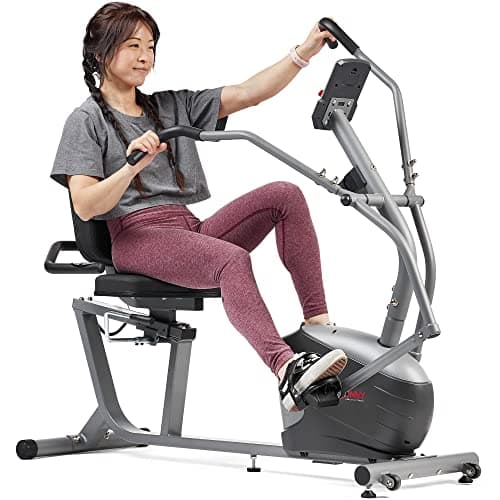
Top pick: Sunny Health & Fitness Smart Recumbent Bike with Dual-Motion Arm Exercisers