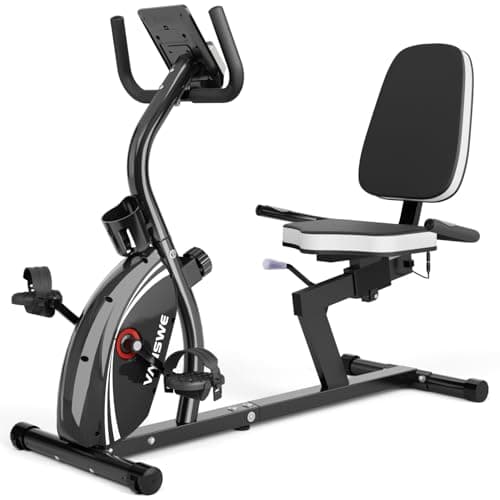
Between 63.8 and 123 pounds assembled, across the bikes whose makers will tell you — and about half of them will not. Here is every published figure, plus the number that actually decides delivery day.
How this is funded: we earn a commission if you buy through our links, at no extra cost to you. It never changes what we recommend, and every page here names at least one thing we would not buy. Full disclosure.
The short answer
63.8 lb to 123 lb assembled, across the bikes in our registry whose makers publish a figure — and roughly half of them do not. The lightest full-size bike we track is a Sunny at 63.8 lb; the heaviest is a Horizon at 123 lb, which is a two-person job. But the number that actually decides delivery day is the shipping weight, which runs 10 to 15 lb heavier than the assembled figure: 91.3 lb on one mid-priced bike, in a carton 56.3 inches long.
People ask this question for one of three reasons, and they want different numbers. If you are wondering whether you can get the box up a flight of stairs, you want the shipping weight and the carton dimensions. If you are wondering whether the bike can be moved out of the way when family visits, you want the assembled weight and whether it has transport wheels. And if you are wondering whether it will stay put while you pedal, you want to know that frame weight is a feature rather than a cost.
This page answers all three from published specifications only. Where a maker does not publish a figure we say so, because in this category that is common enough to be the finding rather than an oversight.
Every published assembled weight
From lightest to heaviest, as the makers state them:
Sunny SF-RB424006 — 63.8 lb. The lightest full-size recumbent bike in our registry, with a published 76 lb shipping weight.
Sunny SF-RB420032 — 77.4 lb, published alongside a 91.3 lb shipping weight in a 56.3 by 9.8 by 23.6 inch box.
Schwinn 290 — 107.6 lb, published by Schwinn on its own site alongside exact assembled dimensions. The box weight is not published.
Horizon 5.0 R — 123 lb, the heaviest machine we cover, shipping in a 66.5 by 11.2 by 31 inch carton. Horizon publishes shipping dimensions as well as assembled ones, which is the single most useful thing a maker can do here.
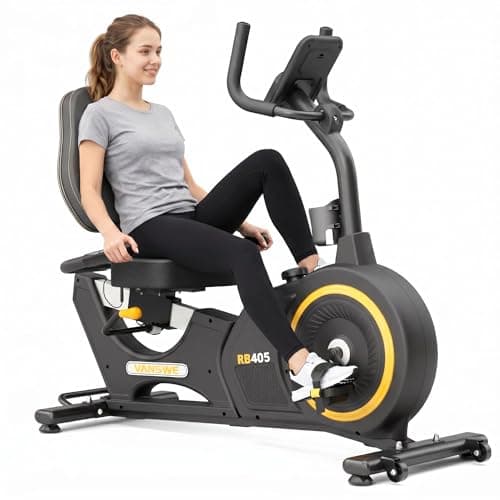
And then the gap. The HARISON HR-B51A, the VANSWE RB405, the VANSWE RB661, the Niceday RC88, the Marcy NS-1201R and the Marcy NS-716R publish no assembled weight we could cite — several publish an assembly claim instead, which is a different question. The Teeter FreeStep, the most expensive machine on this site, publishes neither an assembled weight nor a box weight. For a product that has to be carried into a house, that is a strange omission to find at every price point.
For context from the other side of the site: the walking machines we track are mostly lighter objects, from a published 41.47 lb to 67.7 lb, which surprises people until they remember that a bike has to be heavy enough to sit still while you push against it.
The number that actually matters is the box
The assembled weight is the number you will live with. The shipping weight is the number you have to survive once. And the gap between them is consistent: on the two bikes publishing both figures it is 13.5 lb and 12.2 lb, which is packaging, tools, manual and foam.
That turns into a practical rule. If a listing publishes an assembled weight of 100 lb and nothing else, plan for about 110 to 115 lb arriving at your door in a single carton. Most couriers will put it where the driveway meets the house and no further.
Carton length matters as much as weight, and almost nobody checks it. Two bikes here publish cartons over 56 inches long, one over 66 inches. A long box does not bend round a stair turn or through a narrow hallway doorway, and a 66 inch carton is longer than many interior landings are wide. Horizon publishes its shipping dimensions specifically so you can check it through your door, and that is worth more than a precise assembled weight.
Three things worth arranging before it arrives, none of which cost anything: decide which room it is going in, measure the narrowest point on the route, and have somebody available on the day. Unboxing where the bike will live rather than carrying an assembled machine through the house is the single biggest difference between a frustrating delivery and a dull one.
What the makers publish
Four bikes on the weight and footprint figures their makers publish. Blanks are the manufacturer's, not ours.
Machine
Assembly and box weight
Footprint
Weight capacity
Sunny Health & Fitness 16-Level Smart Magnetic Recumbent Bike with Workout Bands
76 lb shipping weight; 63.8 lb assembled
51.8 in long × 25.6 in wide × 46.1 in high
300 lb
HARISON Recumbent Exercise Bike, 450 lb capacity
Not published by the manufacturer
54.6 in long × 25.7 in wide × 46.2 in high
450 lb
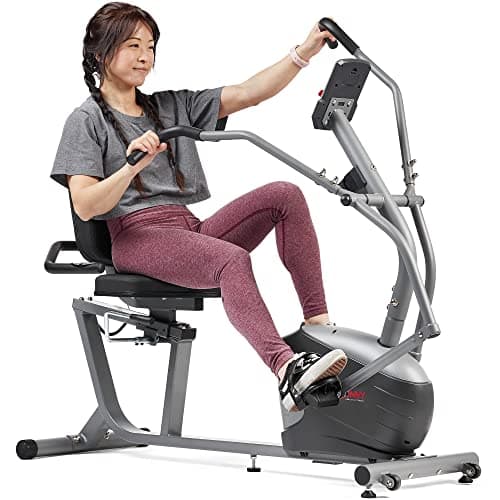
Sunny Health & Fitness Smart Recumbent Bike with Dual-Motion Arm Exercisers
91.3 lb shipping weight, in a 56.3 × 9.8 × 23.6 in box; 77.4 lb assembled
63.8 in long × 26.4 in wide × 49.6 in high
265 lb
Schwinn Fitness 290 Recumbent Bike
107.6 lb assembled; box weight not published
66.4 in long × 28 in wide × 47 in high
330 lb
Read across the HARISON’s row and you get this page’s central irony: it is the bike that publishes the most about movingit — front transport wheels and a lifting handle, stated as design features — and it publishes no weight at all. Knowing a machine has wheels without knowing what they are carrying is half an answer, and it is the kind of gap that only shows up when you line the listings next to each other.
Why heavier is partly the point
It is tempting to read this whole page as an argument for the lightest machine, and that would be the wrong conclusion. A recumbent bike is something you push against, and a frame that flexes or shifts under load feels unsafe long before it is unsafe — which for a nervous first-time buyer is enough to end the habit.
Frame weight and published capacity tend to move together, and the heaviest machines we track are also among the ones publishing the highest capacities. There is a real trade here rather than a free lunch: the bike that is easiest to move is rarely the one that feels most planted at the top of the resistance range.
The sensible resolution for most buyers is the middle of the range, plus published transport wheels. If floor space rather than weight is your binding constraint, our small-spaces shortlist ranks the category on published footprint instead, and the honest fact there is that a recumbent bike does not fold — it is a 50 to 66 inch object that lives where you put it. If that is the dealbreaker, a seated pedal unit or a walking pad are the categories that actually put away, and our small home gym guide works through the combinations.
One last thing, which is less about the bike than about the day it arrives. The National Institute on Aging recommends talking to your doctor before starting a new exercise program — and wrestling a 110 lb carton up a staircase is a different activity from the gentle cycling you bought it for. Get help with the box. The bike is the easy part.
General information, not medical advice. Tread & Tone is written by an enthusiast, not a clinician. Nobody here is a doctor, a physical therapist or a trainer, and nothing on this site has been medically reviewed. Talk to your doctor or physical therapist before starting something new, particularly after surgery, a fall, or a change in medication.
Questions people ask
How much does a recumbent exercise bike weigh?+
Across the bikes in our registry whose makers publish an assembled weight, the range is 63.8 lb to 123 lb. The lightest is a mid-priced Sunny at 63.8 lb; the heaviest is a premium Horizon at 123 lb, which is a two-person job to reposition. About half the bikes we track publish no assembled weight at all, which is one of the more common blanks in this category.
Why is the box heavier than the bike?+
Because the box contains the bike plus the packaging, the tools, the manual and the protective foam. The gap is usually 10 to 15 lb: one bike publishes 91.3 lb shipping against 77.4 lb assembled, another 76 lb shipping against 63.8 lb assembled. That matters because the shipping weight is what arrives at your door in one piece, and it is the number that decides whether you can get it inside yourself.
Can one person move a recumbent bike?+
It depends on the bike and on whether it has transport wheels. A 63.8 lb bike with wheels can be tilted and rolled between rooms by most people; a 123 lb machine is a two-person lift even with wheels, because tilting it to engage them is itself the hard part. Look for published transport wheels and a lifting handle — two bikes in our registry publish both, and one publishes them as an explicit accessibility feature.
Do I need the bike to be heavy for stability?+
To a point, yes, and this is why a bike is not built light. A machine you push against has to stay still, so frame weight and a published weight capacity tend to move together — the heaviest bikes we track are also the ones with the highest published capacities. The practical balance is to buy enough weight to feel planted and no more than you can position, which for most buyers means the middle of the range rather than either end.
What weight should I check before ordering?+
The shipping weight and the carton dimensions, not the assembled weight. The box is what a courier leaves at your door, and the carton length is what decides whether it fits through a hallway or round a stair turn — two of the bikes here publish cartons over 66 inches long. If a listing publishes only one of those two, assume the box is 10 to 15 lb heavier than the assembled figure and ask the seller for the carton size.
Which recumbent bike is lightest?+
Of the bikes whose makers publish a figure, the Sunny SF-RB424006 at 63.8 lb assembled, which also publishes a 76 lb shipping weight. It is the full-size bike we would pick if the machine has to move between rooms, and it pairs that with a flip-away side handle that clears the way as you get on and the second-lowest published inseam minimum in our registry at 27.2 inches.
Is assembly hard on a heavy bike?+
The makers' claims are all we have, and we have not assembled any of these machines. What they publish: one states 90 percent pre-assembled with tools included, one states 80 percent, one states 70 percent with a claimed one-hour setup, and several publish nothing at all. Treat those percentages as marketing rather than measurement — what they do tell you is which makers thought the question was worth answering.
CDC — Older Adult Activity: An Overview — At least 150 minutes a week of moderate-intensity activity, 2 days of muscle strengthening, plus balance activities for adults 65 and over (read July 24, 2026)
Product measurements are cited individually inside each Fit-to-You panel, against the manufacturer page or dated retailer listing they were read from.
The handful of measurements that actually decide whether a seated bike fits your body and your room — seat range, capacity, resistance control and step-through — and the specs you are paying for that do not matter.
Published footprints from 50 inches long to over five and a half feet, ranked smallest first — plus the clearance nobody publishes, and the one machine that tells you what size box arrives.
Top pick: VANSWE Recumbent Exercise Bike, 450 lb capacity
What each price band actually buys — from the entry-level step-through frames to the machines over $1,000 — and the point where the extra money stops improving anything a senior buyer needs.
One machine, a balance pad and a set of bands in the corner of a spare room, laid out so it actually gets used, on a small budget and a smaller footprint.
Step-through bikes around $300 and under that still publish a real weight capacity and seat range — ranked on value, with the one we tell you to skip even at this price.