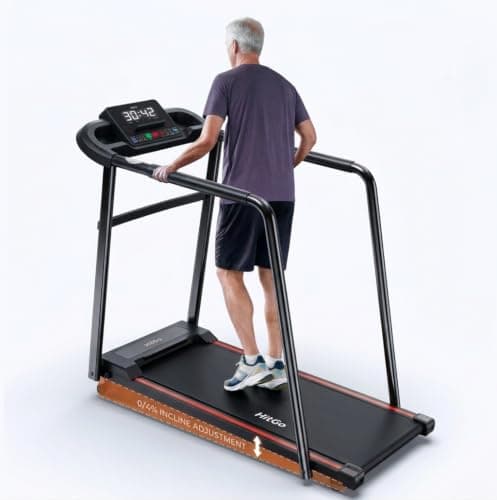
For most people, yes — and the two specifications that decide it are the slowest speed the belt will hold and whether the maker will tell you anything at all about what is under the deck.
How this is funded: we earn a commission if you buy through our links, at no extra cost to you. It never changes what we recommend, and every page here names at least one thing we would not buy. Full disclosure.
The short answer
For most people, yes— walking is one of the activities the Arthritis Foundation recommends for osteoarthritis, and the reason is mechanical rather than aerobic: moving the joint produces the fluid that lubricates it. Two specifications decide whether a pad in particular will work for you: the slowest speed the belt will hold (0.5 to 0.6 mph on the best of them, unpublished on three) and what the maker will tell you about the deck. If walking already hurts, start with a seated bike instead and come back to the belt later.
The instinct that brings people to this question is that walking must be bad for a worn knee — it is weight-bearing, it is repetitive, and it is the thing that hurts. The evidence runs the other way, and the Arthritis Foundation puts it plainly: movement helps osteoarthritis rather than aggravating it. NIAMS lists the knee among the joints osteoarthritis most commonly affects, and the practical consequence of a joint that is not used is a joint that stiffens and a thigh muscle that weakens, which leaves even more load on the cartilage that is already worn.
So the question is not really whether to walk. It is how to walk enough, often enough, without the session costing you the next day — and that is a question about the machine. Nothing here is medical advice, and a knee with a specific diagnosis deserves a specific plan from whoever is managing it.
Why a belt can be kinder than a pavement
Three real advantages, none of which are the ones the listings advertise.
You control the speed exactly, and it never changes. Walking outdoors means keeping up with a companion, crossing a road before the light changes, and whatever the ground does. A belt at 0.6 mph stays at 0.6 mph. For a joint that has a comfortable pace and an uncomfortable one, the ability to sit precisely on the comfortable side is worth more than any cushioning claim.
The surface is flat and predictable. No kerbs, no camber, no uneven slabs. A knee that is unhappy about a sideways load gets nothing but straight-ahead steps, which is also why a belt is a reasonable place to rebuild confidence after a flare.
You can stop the moment it complains.This is the one that gets underrated. Fifteen minutes from home on foot, the decision to stop costs you a fifteen minute walk back. On a pad it costs nothing, which makes short frequent sessions realistic — and the Arthritis Foundation’s guidance on building volume is about gradual accumulation rather than heroic single efforts.
The two specifications that decide it
First: how slow the belt will go. Every listing in this category leads with a top speed, which for an arthritic knee is the least relevant number on the page. The figure that matters is the minimum, and it varies more than you would expect: the slowest published minimums among the walking machines we track are 0.5 and 0.6 mph, a few publish only a top speed, and two publish nothing about speed at all. A machine that will not go below 1 mph is not a machine for a cautious first fortnight.
Second: what is under the deck, and whether anybody will say. Cushioning reduces the peak force at heel strike, and heel strike is the moment a sore knee notices. Here is the honest state of the category: two of the nine machines we track publish a countof what is underneath — one states six shock absorbers under a six-layer belt, another seven layers with ten shock-absorption points — and not one publishes a figure for how much force any of it absorbs. A count tells you the maker thought about the problem. It does not tell you the answer, and we are not going to pretend otherwise. Our explainer on treadmill cushioning goes through what the different constructions actually do.
A third thing worth checking, below those two: whether the deck can be flat.One machine in our registry publishes a 0 to 2 percent incline range with an explicit true 0 percent setting. Incline increases the work at the knee, so starting flat matters — and a deck with a built-in rise cannot be flattened later.
What the makers publish
Three walking machines on the two specifications this page ranks, plus what there is to hold. Blanks are the manufacturer's, not ours.
Machine
Minimum speed
Handrails
Weight capacity
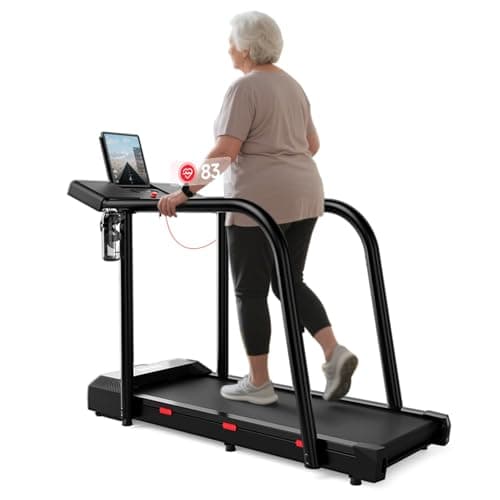
Yesoul Walking Treadmill for Seniors with Long Handrails
0.6 mph to 3.8 mph
Extended handrails for support; length in inches not published
300 lb
Redliro Treadmill for Seniors with Long Handrails
0.5 mph to 5 mph
Full-length rails spanning the deck, with speed buttons mounted on the rails. Length in inches not published
300 lb
KALWOL Walking Pad with 14 Percent Auto Incline
0.6 mph to 6.2 mph on a stated 3.5 HP brushless motor
None. There is nothing to hold
Published twice and differently: 400 lb in the listing title, 350 lb in the specification bullet. The listing does not reconcile them
The pattern in that table is the finding. The two machines that publish rails and the slowest speeds are the two sold specifically to older walkers — and they are also the two that publish no belt dimensions at all. The machine with the most detailed published cushioning construction has nothing to hold onto. Nobody in this category gives you everything, so the sensible approach is to decide which of these constraints is yours and buy for that one.
How to use it without paying for it the next day
Four rules, in the order they matter.
Start at the bottom speed and stay there for a week. The temptation is to treat 0.6 mph as a warm-up setting you pass through. Treat it as the setting, and let the only variable be minutes.
Split the time. Ten minutes after breakfast and ten after dinner is kinder to an arthritic knee than twenty in one go, and the CDC counts the minutes the same either way. Short bouts also mean a bad day costs you ten minutes rather than a whole session.
Use the next morning as your instrument.Some stiffness that eases as you move is normal. A knee that is more swollen or more painful the following day than it was before means the session was too long or too fast. That is information, not failure — scale it back and build again.
Keep the quadriceps work going separately. Walking maintains the joint but it is not strength training, and the muscle around the knee is what shares the load. Our light dumbbell routine and the chair exercise guide both have seated work that does not add any load to the joint. If you are working with a physio, theirs beats ours.
General information, not medical advice. Tread & Tone is written by an enthusiast, not a clinician. Nobody here is a doctor, a physical therapist or a trainer, and nothing on this site has been medically reviewed. Talk to your doctor or physical therapist before starting something new, particularly after surgery, a fall, or a change in medication.
Questions people ask
Is walking good or bad for knee arthritis?+
For most people it is good, and the Arthritis Foundation is direct about why movement helps osteoarthritis rather than aggravating it. The mechanism is not fitness: moving a joint through its range produces the fluid that lubricates it, and the muscle you keep around the knee is what shares the load. What makes walking uncomfortable is usually too much too soon rather than walking itself. Whether it is right for your knee, and how much, is a question for whoever manages it.
Is a walking pad easier on the knees than a treadmill?+
Not inherently, and in two respects it is usually worse. A full-size treadmill has a longer deck, a thicker cushioning system, proper handrails and a real incline range; a walking pad trades all four for a shape that slides under a sofa. What a pad does better is the step-up — the two machines publishing a deck height state about 4.1 to 4.3 inches, which is a smaller step than most treadmills — and it makes short, frequent sessions easy, which is the pattern a sore knee tolerates best.
What speed should I walk at with knee arthritis?+
Start at the slowest speed the machine will hold and add minutes before you add speed. The slowest published minimums among the machines we track are 0.5 and 0.6 mph, which is slower than an unhurried indoor pace. That is the setting for a first week, and there is no prize for leaving it early. The Arthritis Foundation's guidance on building activity volume is to increase gradually and to judge intensity by how you feel rather than by a number on a console.
Does treadmill cushioning actually protect the joint?+
It reduces the peak force at the moment your heel lands, which is the force a sore knee notices most — but nobody in this category quantifies it. Two of the nine walking machines we track publish a count of what is under the belt: one states six shock absorbers under a six-layer belt, another seven layers with ten shock-absorption points. Nobody publishes a figure for how much force any of that absorbs, so a count is a sign the maker thought about it, not a measurement of the benefit.
Should I buy a bike instead?+
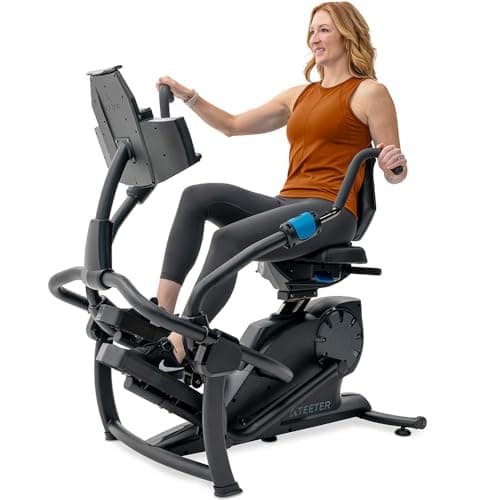
If walking hurts your knee now, probably yes, at least to begin with. A recumbent bike unloads the joint almost entirely while still moving it through its range, which is the same lubrication mechanism the Arthritis Foundation describes for cycling — and it is the reason our arthritis shortlist is built on seated machines. Many readers end up with both: the bike for the days the knee complains, the pad for the weight-bearing walking that a bike cannot provide.
How long should a session be?+
Shorter and more often than you would guess, especially in the first fortnight. Ten minutes twice a day is a kinder introduction for an arthritic knee than twenty minutes once, and the minutes count the same toward the CDC's 150-a-week target for adults 65 and over. If the knee is sorer the next morning than it was before, that session was too long or too fast — scale back rather than pushing through, and raise a pattern of worsening pain with your clinician.
Does incline help or hurt an arthritic knee?+
It generally increases the work at the knee, so it is not where to start. One machine we track publishes a true 0 percent setting alongside its 0 to 2 percent range, which is worth knowing because a deck with a built-in rise cannot be flattened. If you want to add difficulty later, adding minutes or a small amount of speed is usually gentler on the joint than adding gradient — and worth asking your physio about first.
NIAMS — Osteoarthritis — The most commonly affected joints include the hands, knees, hips, neck and lower back; with hip osteoarthritis "You might feel pain and stiffness in the hip joint or in the groin, inner thigh, or buttocks", the pain can radiate to the knee, and "Over time, you may not be able to move your hip as far as you did in the past" (read October 5, 2026)
Two machines here publish what is underneath the belt; the rest just describe it. Ranked on published cushioning, the slowest speed the belt will hold, and what there is to hold onto.
Top pick: Yesoul Walking Treadmill for Seniors with Long Handrails
Most treadmill knee pain traces to three things you can change without buying anything — speed, stride and the deck under you. When it's the machine, and when it's the doctor.
A walking pad is not a small treadmill. Four numbers decide it — belt length, what there is to hold, the slowest speed and the weight you have to move — and most listings publish two of them.