Best for Arthritis
Best Exercise Bikes for Arthritis
Which seated machines keep the joint moving through its range without loading it — and the one that isn't a bike at all.
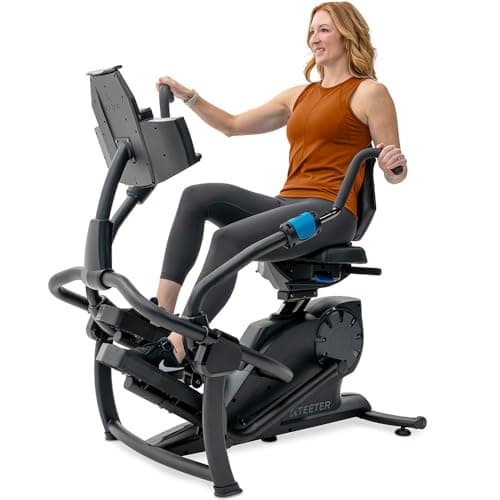
Top pick: Teeter FreeStep Recumbent Cross Trainer
Yes — NIAMS lists biking among the low-impact activities it calls especially helpful. The difficulty is never the bike. It is finding a setting low enough to repeat tomorrow, which is a specification question almost nobody treats as one.
How this is funded: we earn a commission if you buy through our links, at no extra cost to you. It never changes what we recommend, and every page here names at least one thing we would not buy. Full disclosure.
The short answer
Yes. The NIAMS names it: “Low-impact aerobic activities—such as walking, biking, swimming, and water exercises—are especially helpful.” The same page gives the instruction that actually decides whether a bike helps you or sets you back: “You should start exercising at a low level and gradually increase over time.” Which turns a vague wellness suggestion into a hard equipment specification — because on a bike with eight knob positions, “a low level” may not be available. Buy the machine with the finest low-end resistance and the thickest published seat cushion, and start shorter than feels worth doing.
Most pages answering this question stop at “yes, low-impact exercise is recommended”. That is true and it is not useful, because the problem with exercising with fibromyalgia has never been choosing the activity. It is that the dose which helps and the dose which triggers two bad days are close together, and most home equipment is not built to land between them.
So this page is about the dose, and about which published specifications let you control it.
The effort is a dial, not your body weight.This is the central advantage and it is worth being concrete about. Walking loads you with whatever you weigh and the only way to reduce that is to walk slower, until you are not really exercising. A bike separates effort from gravity completely, which means a genuinely low dose is available — and a genuinely low dose is what the guidance asks for.
The session can be three minutes. A machine ten feet from where you sit makes a three-minute session possible. A gym class does not, a pool does not, and a walk outdoors in February does not. For a condition where capacity varies day to day, the ability to do a tiny amount without it being a production is the single most useful property a piece of equipment can have.
Nothing is held, braced or supported by you. A recumbent has a back rest, so your neck, shoulders and lower back are not working for the duration. For a lot of people with fibromyalgia that is precisely where the tenderness concentrates, which is why we would steer away from an upright bike here even though the pedalling is similar.
The movement itself may be part of the point. The Arthritis Foundation makes the case for cycling’s continuous motion taking joints through their range. And the National Institute on Aging states the general case for chronic conditions directly: “Almost anyone, at any age, can do some type of physical activity, even with a chronic condition.”
What we are not going to do is tell you whether exercise is right for your case, how much to do, or how it interacts with your medication. NIAMS describes fibromyalgia as “a chronic (long-lasting) disorder that causes pain and tenderness throughout the body, as well as fatigue and trouble sleeping”, and treatment as “a combination of exercise or other movement therapies, psychological and behavioral therapy, and medications.” Exercise is one of three. Nobody here is a clinician and nothing on this site has been medically reviewed.
Here is the problem in one sentence. “Start at a low level” assumes the machine has one.
Most recumbent bikes in this category offer 8 or 16 resistance positions on a mechanical knob. On an 8-level machine, the gap between level 1 and level 2 is an eighth of the whole range — which at the bottom end can be the difference between “barely anything” and “that is a workout”. If your usable window sits between them, you do not have a setting; you have a choice of two wrong ones.
The Horizon 5.0 R publishes a 0–100 electronically controlled range, which is the finest increment of any machine on this site. That is not a performance feature — for this reader it is the whole reason to pay more. A hundred steps means the level you worked out last week is a number you can return to exactly, which is what “gradually increase over time” actually requires.
The second specification nobody discusses: seat cushion thickness. For a condition defined by tenderness, twenty minutes on a thin seat is its own problem, regardless of how light the resistance is. Exactly one machine on this site publishes a cushion figure — the VANSWE RB405, at 3.4 inches. Everybody else describes their seat as comfortable, which is not a number.
The third: flywheel weight. At very low resistance a light flywheel gives you a lumpy rotation — push, dead spot, push — and that uneven loading is harder on a sensitised system than a smooth one. The Niceday RC88 publishes a 15 lb flywheel, the heaviest in the budget-to-mid band here.
| Machine | Controls and reach | Inseam range | Weight capacity |
|---|---|---|---|
| Horizon Fitness 5.0 R Recumbent Bike | 0–100 resistance at the touch of a button; seat adjusts horizontally on an aluminum rail; QuickZip pedals | Not published by the manufacturer | 300 lb per Horizon's own specification. The Amazon listing claims 350 lb — the two disagree |
| VANSWE Recumbent Exercise Bike, 450 lb capacity | Backlit LED monitor; 8-level resistance knob; continuous seat slider | 29 in to 40 in leg length (stated rider height 5 ft 1 in to 6 ft 4 in) | 450 lb |
| Niceday Recumbent Exercise Bike RC88 | Mechanical resistance knob, 16 levels; LED monitor; tablet holder | Eight seat positions, stated to suit riders up to 6 ft 3 in. No minimum inseam published | 400 lb |
Note what is missing across all three: no seat height, no step-over height, and no display character height. On machines sold heavily to people who are shopping precisely because getting onto things is hard. Measuring the step-over yourself takes a minute and is worth doing inside the return window.
NIAMS’s self-care advice is the line to build a routine around: “Pace yourself during the day. You may not be able to do all the things you once did, or not in the same amount of time.” Translated into a bike routine, that produces four rules.
Set the starting dose by what you could repeat tomorrow.Not by what you can manage today. If three minutes is repeatable and ten minutes is not, the correct dose is three minutes — and it will feel absurd. Do it anyway for a fortnight.
Add minutes before resistance, one variable at a time. Changing both at once means a bad week tells you nothing about which change caused it.
Do not spend a good day. This is the single most common setback pattern and the NIA names it for chronic pain generally: avoid overexercising on good days. A good day is for doing your normal dose comfortably, not for catching up.
Judge by tomorrow morning. Not by the session, and not by the hour after. The feedback loop for this condition is slow, which is exactly why intuition is a poor guide to dosing it. Our guide to session length covers how that progression usually looks over the first couple of months.
One more thing worth doing: keep a two-column note of minutes and resistance level for the first month. It sounds fussy. It is the only way to tell a flare caused by the bike from a flare that was going to happen anyway, and that distinction decides whether you keep exercising.
Related reading: low-impact cardio for seniors covers the alternatives NIAMS names alongside biking, and warming up and cooling down matters more here than on most pages — a cold start into even a light session is a common trigger.
General information, not medical advice. Tread & Tone is written by an enthusiast, not a clinician. Nobody here is a doctor, a physical therapist or a trainer, and nothing on this site has been medically reviewed. Talk to your doctor or physical therapist before starting something new, particularly after surgery, a fall, or a change in medication.
Yes, and it is named in the guidance rather than merely tolerated by it. NIAMS lists the activities it considers most useful directly: 'Low-impact aerobic activities—such as walking, biking, swimming, and water exercises—are especially helpful.' A seated bike adds two things to that: the effort is a dial rather than your body weight, and the session can be three minutes without anybody noticing. Exercise is one component of treatment, which NIAMS describes as a combination of movement therapies, psychological and behavioral therapy, and medications.
Lower than feels worth doing, and NIAMS says so plainly: 'You should start exercising at a low level and gradually increase over time.' The specific trap is that the right starting effort often feels pointless, so people start at a level that feels like exercise and pay for it over the following two days. The honest test of a starting level is not how it feels during the session — it is whether you could do the same thing tomorrow.
That is a question for the clinician managing your case, and the answer is person-specific. What the published guidance offers is pacing rather than a rule: NIAMS's self-care advice is to 'Pace yourself during the day. You may not be able to do all the things you once did, or not in the same amount of time.' The National Institute on Aging makes the same point for chronic pain generally — listen to your body and avoid overexercising on good days, which is where most setbacks come from.
Recumbent, for most people, and the reason is the back rest rather than the pedals. An upright asks your neck, shoulders and lower back to hold you up and support your arms for the whole session, which is asking those specific areas to work — and for many people with fibromyalgia the neck and shoulders are exactly where the tenderness is worst. A recumbent takes that work away entirely. The pedal stroke itself is much the same.
Three things. A resistance scale with fine steps at the bottom, so your starting level is a setting rather than a compromise — the Horizon 5.0 R publishes 0 to 100 electronically controlled levels against the 8 or 16 knob positions most machines offer. A seat you can live on, which means a published cushion thickness; the VANSWE RB405 publishes 3.4 in, and it is the only machine on this site that publishes a cushion figure at all. And a heavy enough flywheel that the stroke is even at low resistance rather than lumpy.
Start at a length you are confident you can repeat the next day, even if that is three minutes, and add minutes before you add resistance. The guidance's own framing is gradual increase from a low level, and the practical version for a condition with flares is that consistency beats volume by a wide margin: five minutes daily is a better intervention than twenty minutes twice followed by a week off. If a session leaves you worse the following morning, the previous session was the problem, not the morning.
Product measurements are cited individually inside each Fit-to-You panel, against the manufacturer page or dated retailer listing they were read from.
Best for Arthritis
Which seated machines keep the joint moving through its range without loading it — and the one that isn't a bike at all.
Top pick: Teeter FreeStep Recumbent Cross Trainer
What 'low-impact' actually means, the five kinds of gear that deliver it, and how to pick the one that fits your joints, your balance and your room.
Read the guideThe CDC's weekly number, divided into sessions that are actually achievable — and why the first two weeks should be shorter than you think.
Read the guideBest for Seniors
Eleven bikes ranked on the measurements that decide whether you can get on — with the count of specs each manufacturer refuses to publish.
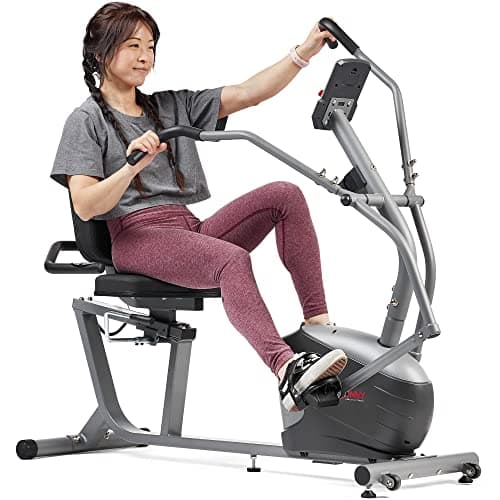
Top pick: Sunny Health & Fitness Smart Recumbent Bike with Dual-Motion Arm Exercisers
Hip range of motion is what decides this, and it is set by seat distance rather than by the machine. How to tell before you buy whether your hip will tolerate the stroke.
Read the guideFive minutes at each end that make the middle safer and more comfortable, a gentle routine for stiff joints, and why the machine itself is the easiest warm-up there is.
Read the guide