Best for Arthritis
Best Exercise Bikes for Arthritis
Which seated machines keep the joint moving through its range without loading it — and the one that isn't a bike at all.
Top pick: Teeter FreeStep Recumbent Cross Trainer
Usually yes, and the reason is simple: your weight is in the seat instead of on the joint. What decides it is not the machine but how much your hip has to bend — and that is a seat setting you control.
How this is funded: we earn a commission if you buy through our links, at no extra cost to you. It never changes what we recommend, and every page here names at least one thing we would not buy. Full disclosure.
The short answer
Usually yes. A recumbent bike puts your weight in the seat rather than through the hip, and the resistance is a setting you choose rather than your own body weight. The variable that decides it for your hip is how far it has to bend at the top of the stroke, which is set by seat distance — move the seat back until the pain at the top clears, stopping before your knee locks straight.
Hip pain is the complaint where the machine matters least and the setup matters most, and almost nothing written about it says so. The pedal stroke on a recumbent bike is very similar from one machine to the next. What differs enormously is how much hip flexion that stroke demands of you, and that is almost entirely a function of where the seat is.
So this page is mostly about one adjustment. But first, the reason the category suits this complaint in the first place.
Your weight is not going through the joint. Walking loads the hip with your full body weight on every step, and there is no dial. On a bike, your weight is in the seat and the load on the joint is whatever the resistance setting says it is. That one difference is why people whose hips have stopped tolerating a walk can often still ride.
The movement itself is usually the helpful part. The Arthritis Foundation makes the point that cycling’s continuous motion takes the joint through its range, which is what produces the fluid that lubricates it. And the National Institute on Aging is direct about the general case: “When done safely, being physically active with arthritis shouldn’t make the disease or pain worse.”
Getting on is easier.A recumbent is a step-through frame — you walk through the gap rather than lifting a leg over a crossbar. For a hip that objects to being abducted and lifted, that is often the single most painful movement in the whole session, and this category removes it.
What we are not going to tell you is whether it is right for your hip. Nobody here is a clinician and nothing on this site has been medically reviewed. What NIAMS describes for hip osteoarthritis is pain and stiffness in the hip joint or in the groin, inner thigh or buttocks, pain that can radiate to the knee, and a hip that over time cannot move as far as it used to. That last part — the shrinking range — is exactly why the next section is the important one.
Here is the mechanism in plain terms. At the top of each pedal rotation, your knee comes toward your chest. How far it comes is set by how close the seat is. Close seat, deep hip flexion. Further seat, shallower hip flexion.
A hip with reduced range will complain at the end of that range — which means a seat that is too close produces pain at the top of each stroke, rhythmically, once per rotation. That is the single most common reason somebody tries a bike, hurts, and concludes cycling is not for them.
The fix, in order:
Which makes how far the seat travels a real buying specification rather than a detail. Two machines we list publish continuous sliders with a stated leg-length range, and one of those publishes the longest travel anywhere on the site: 29 to 40 inches. Our seat setup guide covers the whole sequence, and it is worth four minutes before the first ride.
If you have moved the seat as far back as it goes and the top of the stroke still hurts, the issue is the shape of the motion rather than its position — and there is a different family of machine for that.
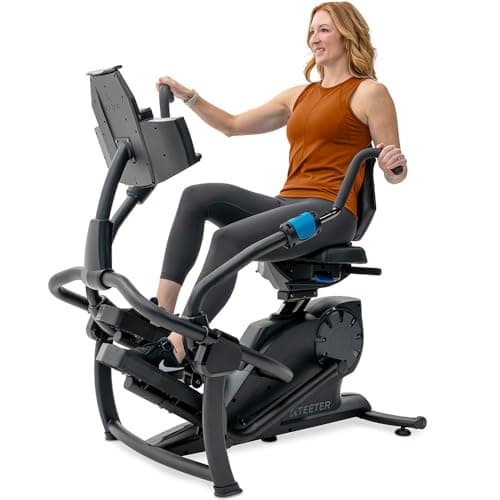
A recumbent cross-trainer moves the pedals along a straight line or an ellipse instead of a circle. The Teeter FreeStep is the clearest example: Teeter publishes a linear stepping motion rather than a circular pedal stroke, which is a genuinely different joint path and not a marketing distinction. For a hip or knee that objects to the arc of a circular stroke, that difference can be the whole decision.
Two caveats we will not leave out. The Teeter is the most expensive machine on this site by a wide margin and has the largest footprint of any seated machine we list — 59 inches long by 32.7 inches wide. And its physical-therapy licensing claim concerns the stride patent, not evidence that it will help your particular hip.
Our bike-versus-cross-trainer comparison sets the two motions side by side, and the cross-trainer shortlist ranks the whole family on published weight capacity, which is the spec that decides whether they are even an option.
| Machine | Weight capacity | Inseam range | Footprint |
|---|---|---|---|
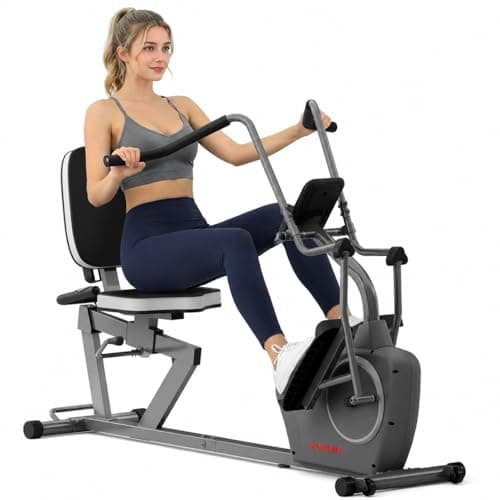
| VANSWE Recumbent Exercise Bike, 450 lb capacity | 450 lb | 29 in to 40 in leg length (stated rider height 5 ft 1 in to 6 ft 4 in) | 50 in long × 20 in wide × 44 in high |
| Teeter FreeStep Recumbent Cross Trainer | 350 lb; rated for users 4 ft 11 in to 6 ft 6 in | Not given as an inseam; stated rider height range 4 ft 11 in to 6 ft 6 in | 59 in long × 32.7 in wide × 54.8 in high |
| VANSWE Recumbent Elliptical Cross Trainer | 400 lb | 29 in to 37 in on an infinite seat slider (stated rider height 5 ft 2 in to 6 ft 5 in) | 57 in long × 19.8 in wide × 47 in high, from the listing's dimension fields |
Notice that Teeter gives a rider height range rather than an inseam, which is less useful — two people the same height can have very different leg lengths, and it is the leg length that sets the hip angle. We report what each maker publishes rather than converting one into the other, because that conversion would be a guess wearing a number’s clothes.
And across all three: no published step-over height, and no published seat height. On machines sold for exactly this complaint. Measuring it yourself takes about a minute.
This deserves its own paragraph rather than a footnote. Hip replacement commonly comes with specific movement restrictions in the early months, and how far the hip may be flexed is often one of them. Those limits are set by the surgeon who did the operation and they vary by approach and by patient — which means the seat position question on this page becomes a clinical question rather than a comfort one.
Ask directly: is seated cycling allowed, and is there a hip-flexion limit I should stay inside? Then set the seat to respect the answer. Our guide to exercising after a hip replacement covers what to ask and which equipment tends to fit the usual restrictions, without pretending to know your case.
Related reading: is a recumbent bike good for sciatica is the page to read if the pain travels down the leg rather than sitting in the hip or groin, and the bad-knees shortlist is built on resistance granularity, which is the other setting worth getting right.
General information, not medical advice. Tread & Tone is written by an enthusiast, not a clinician. Nobody here is a doctor, a physical therapist or a trainer, and nothing on this site has been medically reviewed. Talk to your doctor or physical therapist before starting something new, particularly after surgery, a fall, or a change in medication.
For most people with hip osteoarthritis, yes — because your body weight sits in the seat rather than going through the joint on every step, and because the resistance is a setting you choose. The Arthritis Foundation points out that cycling's continuous motion takes a joint through its range, which is the part that helps. What decides it for an individual hip is how far that hip has to bend at the top of the pedal stroke, and that is set by seat distance.
Because it sets the hip angle. With the seat close, your knee comes up higher toward your chest at the top of each stroke, which is deeper hip flexion. With the seat further back, the hip stays more open. A hip that is painful at the end of its range will object to the close setting and tolerate the further one — but go too far and the knee locks straight, which creates a different problem. The target is the furthest setting that still leaves a visible bend in your knee.
The recumbent, usually, for two reasons that have nothing to do with the hip joint itself. You step through the frame instead of lifting a leg over a crossbar, which is the movement most likely to hurt getting on. And the back rest means you are not holding yourself up through your hips and lower back for 20 minutes. The pedal stroke itself is similar on both.
That is a question for your surgeon or physical therapist, and it is one where the answer genuinely varies — hip replacement often comes with specific movement limits in the early months, including on how far the hip may be flexed. Those limits are the whole point of asking. We have a guide to exercising after a hip replacement that covers what to ask and what equipment tends to fit the restrictions, but the restrictions themselves come from the person who did the operation.
Move the seat back one notch and try again. Pain concentrated at the top of each rotation is almost always too much hip flexion, and it is a setup problem rather than a reason to stop. If moving the seat back far enough to clear the pain leaves your knee locking straight, the circular stroke may not suit that hip — which is where a machine with a linear stepping motion becomes worth considering.
The NIA puts it plainly for arthritis generally: 'When done safely, being physically active with arthritis shouldn't make the disease or pain worse.' The usual caution is about load and progression rather than about movement itself. Where people get into trouble is adding resistance quickly, or doing a long session on a good day and paying for it the next morning. Add minutes before resistance and judge by how you are tomorrow.
Product measurements are cited individually inside each Fit-to-You panel, against the manufacturer page or dated retailer listing they were read from.
Best for Arthritis
Which seated machines keep the joint moving through its range without loading it — and the one that isn't a bike at all.
Top pick: Teeter FreeStep Recumbent Cross Trainer
Hip precautions change which machines are sensible and which are off-limits at first. What that means for bikes, treadmills and seated cardio, and why your care team decides.
Read the guideThe seat distance decides whether the bike helps your knees or hurts them, more than the machine does. How to set it in two minutes, and the leg angle to aim for.
Read the guideBoth seat you with your back supported. One turns a circle, the other steps a straight line — and for some arthritic knees that single difference is the whole decision.
Read the guideSciatica is a symptom, not a diagnosis — so the honest answer depends on what is pressing on the nerve, and on one seat adjustment almost nobody mentions.
Read the guideBest Cross-Trainer
Seated ellipticals that swap the circular pedal stroke for a stepping stride — ranked on which makers publish a weight capacity and which hide it.
Top pick: VANSWE Recumbent Elliptical Cross Trainer