Is a Recumbent Bike Good for Spinal Stenosis?
The one condition where the seated position is not a compromise but the point: NIAMS describes lumbar stenosis symptoms easing in flexion, and names exercise bicycles outright.
Read the guideIt depends on something most pages skip: sciatica is a symptom, not a diagnosis. What is pressing on the nerve decides whether sitting helps or hurts — and one seat adjustment matters more than the machine.
How this is funded: we earn a commission if you buy through our links, at no extra cost to you. It never changes what we recommend, and every page here names at least one thing we would not buy. Full disclosure.
The short answer
It depends on the cause. Sciatica is a symptom — MedlinePlus calls it “a symptom of another medical problem, not a medical condition on its own”. If spinal stenosis is behind it, a seated bike often helps and NIAMS names exercise bicycles outright. If a disc is behind it, prolonged sitting is what some people tolerate worst. Either way the deciding setting is seat distance: keep a visible bend in the knee at full extension.
There is a reason every article about sciatica and exercise bikes feels vague, and it is not the writers being careless. It is that the question as asked cannot be answered.
MedlinePlus puts it plainly: sciatica is pain, weakness, numbness or tingling in the leg caused by injury to or pressure on the sciatic nerve, and it “is a symptom of another medical problem, not a medical condition on its own”. The causes it lists include a slipped or herniated disc, spinal stenosis, piriformis syndrome, a pelvic injury or fracture, and spondylolisthesis.
Those are not variations on one thing. They respond differently to the same position, which is why “is cycling good for sciatica” has no single answer and why the useful version of the question is which of those do I have.
Two of the common causes pull in opposite directions when it comes to sitting, and it is worth understanding the shape of that before you spend money.
If spinal stenosis is the cause, the seated position is usually the friendly one. NIAMS describes lumbar stenosis symptoms as worsening with standing or walking and improving when leaning forward, and explains that “sitting or flexing the lower back or neck may relieve symptoms” because the flexed position opens up the spinal column. NIAMS also lists “slowly progressive aerobic activity, such as swimming or using exercise bicycles” among the nonsurgical treatments. If this is your situation, our stenosis page is the one to read — it is a more confident yes than this page can be.
If a disc is the cause, sitting is the position a lot of people find hardest to hold for long, and a 30-minute seated session is a 30-minute held position. That does not make a bike wrong. It makes the duration and the breaks part of the prescription, and it makes this a question for the person treating you rather than for a buying guide.
If piriformis syndrome is the cause, the pressure point is in the buttock rather than the spine, and what you are sitting on starts to matter as much as the spine position. One bike we list publishes a 3.4-inch seat cushion thickness, which is an unusual thing for a manufacturer to state and a relevant one here.
We cannot tell you which of these you have, and we are not going to guess. Nobody at Tread & Tone is a clinician and nothing here has been medically reviewed. But knowing that the question splits three ways is the thing that makes a five-minute conversation at your next appointment useful.
If you take one thing from this page, take this: do not reach for the pedals.
When the seat is too far back, your leg straightens fully at the furthest point of every stroke. Two things follow. The back of the leg is put under repeated tension — the exact structures that are already irritable when the sciatic nerve is involved. And your pelvis rocks from side to side to let the leg reach, which puts small repeated movements into the lower back you are trying to settle.
The fix costs nothing. Set the seat so that at the furthest pedal position there is a visible bend left in your knee, with the ball of your foot on the pedal and your back against the seat back. Then watch your hips for the first minute: if they are rocking, come forward one more notch. Our full seat setup guide takes about four minutes to work through and is the highest-value thing you will do with a new bike.
Which makes the adjustment mechanism a real specification. A seat on pre-drilled holes gives you a fixed set of positions, and your correct one may sit between two of them. A continuously sliding rail puts it exactly where it belongs. And one machine publishes something better still: a rail you can slide with one hand while you are sitting on it, which means you can change position mid-session instead of enduring the one you set.
| Machine | Weight capacity | Inseam range | Footprint |
|---|---|---|---|
| HARISON Recumbent Exercise Bike, 450 lb capacity | 450 lb | 26.5 in to 38.9 in (stated rider height 4 ft 8 in to 6 ft 4 in) | 54.6 in long × 25.7 in wide × 46.2 in high |
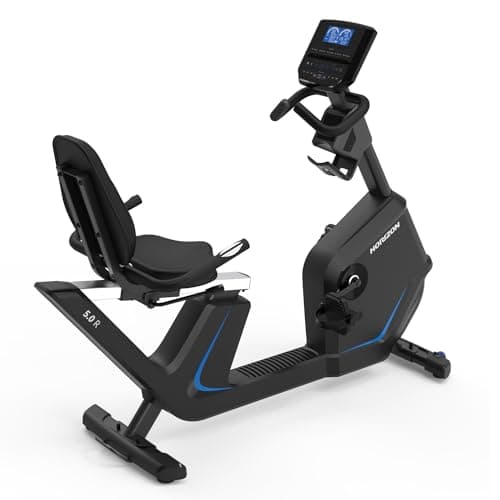
| Horizon Fitness 5.0 R Recumbent Bike | 300 lb per Horizon's own specification. The Amazon listing claims 350 lb — the two disagree | Not published by the manufacturer | 66 in long × 25.2 in wide × 52.2 in high |
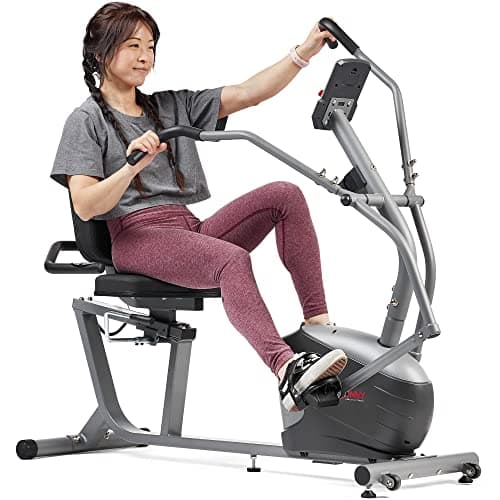
| Sunny Health & Fitness Smart Recumbent Bike with Dual-Motion Arm Exercisers | 265 lb | 29.9 in to 38.6 in | 63.8 in long × 26.4 in wide × 49.6 in high |
The Horizon’s blank inseam cell is a real gap and we are not going to dress it up: it is the machine with the finest resistance control on the site and it will not tell you what leg lengths it fits. The HARISON, at the other end, publishes the lowest inseam minimum we have found anywhere — 26.5 inches.
And across all three, no step-over height. Not one manufacturer on this site publishes it, which is why measuring it yourself is the only reliable route to that answer.
MedlinePlus’s home-care guidance for sciatica is worth reading in full, and three parts of it bear directly on buying a machine. It advises avoiding bed rest, starting back exercises early, and resuming exercise after two to three weeks with work on core strength and spinal flexibility. In other words: movement is the direction of travel, not rest.
What that looks like on a bike:
The National Institute on Aging adds the rule that applies to all of this: with chronic pain, listen to your body, and avoid overexercising on good days. The good days are when people undo a fortnight of progress.
Related reading: recumbent bikes and back pain covers the mechanics in more depth, and the hip pain page is the one to read if the pain sits in the groin or buttock rather than travelling down the leg.
General information, not medical advice. Tread & Tone is written by an enthusiast, not a clinician. Nobody here is a doctor, a physical therapist or a trainer, and nothing on this site has been medically reviewed. Talk to your doctor or physical therapist before starting something new, particularly after surgery, a fall, or a change in medication.
Sometimes, and the deciding factor is what is causing it. MedlinePlus is explicit that sciatica 'is a symptom of another medical problem, not a medical condition on its own' — the common causes include a herniated disc, spinal stenosis and piriformis syndrome. Where stenosis is the cause, a seated position often eases symptoms, and NIAMS names exercise bicycles among the nonsurgical options for it. Where a disc is the cause, prolonged sitting is the position some people tolerate worst. Ask which one you have before you spend anything.
It can, in two specific ways, and both are setup rather than the machine. If the seat is too far back, your leg straightens fully on every stroke and the hamstring and nerve are put under repeated tension — that is the one most likely to flare leg pain. And any single position held for 30 minutes can stiffen up; getting off, standing, and walking for a minute mid-session is not failure, it is good practice.
Not necessarily, and not reflexively. MedlinePlus's home-care advice for sciatica is to avoid bed rest, to start back-strengthening exercises early, and to resume exercise after two to three weeks with work on core strength and spinal flexibility. Rest is not the treatment. Whether sitting specifically eases or aggravates your symptoms depends on the cause, and it is one of the most useful things to be able to tell a clinician.
A recumbent supports your lower back against a seat back and holds your hips flexed in front of you. An upright leans you forward and leaves your lumbar spine unsupported, with your weight going through a narrow saddle. For most people with leg pain from a back problem the recumbent is the easier of the two to tolerate, and it is also the one you can get onto without lifting a leg over a crossbar.
Close enough that your knee keeps a visible bend at the furthest point of the pedal stroke. That one rule prevents the reaching pattern that pulls on the back of the leg. Set it with the pedal at its furthest point and the ball of your foot on it, then check that your pelvis is not rocking side to side as you turn the cranks — if it is, bring the seat forward a notch.
Tomorrow morning, mostly. The useful signal is not how the session feels but how you are the next day: a joint or a nerve that is worse in the morning is telling you the last session was too much. Start with ten minutes at the lowest useful resistance, add minutes before resistance, and if leg pain is consistently worse after riding, take that to your doctor or physical therapist rather than pushing through it.
Product measurements are cited individually inside each Fit-to-You panel, against the manufacturer page or dated retailer listing they were read from.
The one condition where the seated position is not a compromise but the point: NIAMS describes lumbar stenosis symptoms easing in flexion, and names exercise bicycles outright.
Read the guideWhy the back rest is the reason people ask, what it does and doesn't support, and when to ask someone qualified first.
Read the guideThe seat distance decides whether the bike helps your knees or hurts them, more than the machine does. How to set it in two minutes, and the leg angle to aim for.
Read the guideBest for Back Pain
The seat back is the reason people buy this category, and exactly one manufacturer publishes anything about it. Ranked on what each maker documents about back support, seat distance and getting on.
Top pick: Horizon Fitness 5.0 R Recumbent Bike
Price as of October 5, 2026. #ad How we’re funded
Hip range of motion is what decides this, and it is set by seat distance rather than by the machine. How to tell before you buy whether your hip will tolerate the stroke.
Read the guideBest for Seniors
Eleven bikes ranked on the measurements that decide whether you can get on — with the count of specs each manufacturer refuses to publish.
Top pick: Sunny Health & Fitness Smart Recumbent Bike with Dual-Motion Arm Exercisers