Is a Recumbent Bike Good for Sciatica?
Sciatica is a symptom, not a diagnosis — so the honest answer depends on what is pressing on the nerve, and on one seat adjustment almost nobody mentions.
Read the guideOf all the conditions people ask us about, this is the one where the seated position is not a compromise — it is the point. NIAMS names exercise bicycles outright. Here is what that means for which machine to buy.
How this is funded: we earn a commission if you buy through our links, at no extra cost to you. It never changes what we recommend, and every page here names at least one thing we would not buy. Full disclosure.
The short answer
Yes — more confidently than for almost any other condition we write about. NIAMS lists “slowly progressive aerobic activity, such as swimming or using exercise bicycles” among the nonsurgical treatments for spinal stenosis, and describes lumbar symptoms as worsening with standing and walking and improving in flexion. A recumbent bike is aerobic work done sitting down. Buy one with a continuously sliding seat so you can set the distance precisely, and talk to your physical therapist about duration.
Most of the condition questions we get asked have a careful answer, because the honest response to “will this machine help my X” is usually “ask the person who has examined your X”. This one is different, and it is worth explaining why before anything else.
NIAMS describes the typical pattern of lumbar spinal stenosis like this: a burning pain or ache that radiates down the buttocks and into the legs, which “typically worsens with standing or walking and gets better with leaning forward (flexion)”. And on the question of why: “Sitting or flexing the lower back or neck may relieve symptoms. The flexed position ‘opens up’ the spinal column, enlarging the spaces between vertebrae at the back of the spine.”
Read those two sentences next to each other and the shape of the problem is obvious. Walking — the exercise everybody recommends to older adults, including us — is the activity most likely to bring the symptoms on. And sitting is the position that eases them.
Which leads to the sentence that makes this page unusual. In its list of nonsurgical treatments, NIAMS writes: “You may be encouraged to try slowly progressive aerobic activity, such as swimming or using exercise bicycles.” Exercise bicycles, by name, from the National Institute of Arthritis and Musculoskeletal and Skin Diseases. We do not get to quote that for many conditions.
Three things, because the sentence above is easy to over-read and we would rather say this than have you learn it the expensive way.
It is not a treatment claim for your spine.NIAMS lists aerobic activity alongside physical therapy, bracing, medication and, in some cases, surgery. It is one component of a plan a clinician puts together after examining you. Nobody at Tread & Tone is a doctor or a physical therapist, nothing here has been medically reviewed, and imaging alone does not even determine whether your stenosis requires treatment — NIAMS says so explicitly.
It does not mean stop walking. Stenosis symptoms that come on with walking are a reason to talk to someone about how you walk and how far, not automatically a reason to give it up. Walking is the only common activity that is weight-bearing, and a bike does nothing for your bones no matter how hard you pedal. If walking has become difficult, that is a conversation, not a conclusion.
It does not mean any bike will do. Which brings us to the part this site is actually for.
Almost everything that goes wrong with a recumbent bike and a sore back is a setup problem rather than a machine problem, and there are two settings involved.
1. Seat distance.This is the one that matters, and the failure mode is reaching. If the seat is too far back, your leg extends fully on every stroke and your pelvis rocks to follow it — which puts movement into exactly the part of the spine you are trying to settle. Set it so that at the furthest point of the pedal stroke there is a visible bend left in your knee. Never locked straight.
Which makes the adjustment mechanism a real specification rather than a detail. A seat on pre-drilled holes gives you a handful of positions and your correct one may fall between two of them. A continuously sliding rail lets you put it exactly where it belongs. Two bikes we list publish continuous sliders with the leg-length range stated.
2. Resistance.Start lower than feels worthwhile. The thing NIAMS calls “slowly progressive” is doing a lot of work in that sentence, and a bike with eight coarse levels may not have a setting light enough to begin at. One machine we list publishes 0–100 electronically controlled resistance, which is the finest adjustment anywhere in this category and the reason it appears below.
Everything else — the display, the app, the programs — is secondary. Our seat position guide walks through the whole setup in order, and it is worth reading before the machine arrives rather than after.
| Machine | Weight capacity | Inseam range | Footprint |
|---|---|---|---|
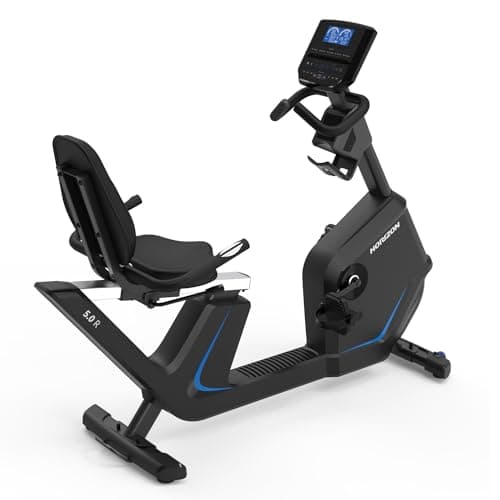
| Horizon Fitness 5.0 R Recumbent Bike | 300 lb per Horizon's own specification. The Amazon listing claims 350 lb — the two disagree | Not published by the manufacturer | 66 in long × 25.2 in wide × 52.2 in high |
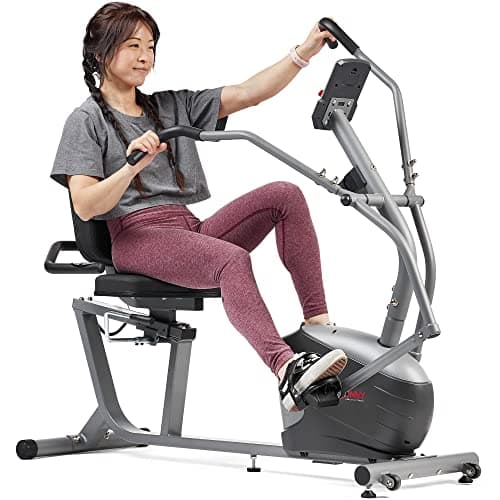
| Sunny Health & Fitness Smart Recumbent Bike with Dual-Motion Arm Exercisers | 265 lb | 29.9 in to 38.6 in | 63.8 in long × 26.4 in wide × 49.6 in high |
| Sunny Health & Fitness 16-Level Smart Magnetic Recumbent Bike with Workout Bands | 300 lb | 27.2 in to 35.8 in | 51.8 in long × 25.6 in wide × 46.1 in high |
One thing to notice: not one of them publishes a step-over height, and only one publishes a seat height. Those are the two measurements that decide whether you can get onto the machine on a bad morning, in a category marketed to exactly this buyer. We show you how to measure it yourself in about a minute, which is faster than waiting for the industry to change.
You will also notice the Horizon publishes no inseam range at all, which is a genuine gap on the machine we otherwise rate highest here. We are not going to hide that to make the recommendation cleaner.
NIAMS’s own self-care advice for spinal stenosis is to get regular exercise — it suggests at least three times a week for 30 minutes — to modify activities that make the pain worse, and to pace things so you do not overdo it. Translated to a machine in a spare room, that looks like this.
The National Institute on Aging puts the general principle better than we can: almost anyone, at any age, can do some type of physical activity even with a chronic condition, and building up slowly is what makes it safe. The machine is the easy part of that sentence.
Two related pages worth your time: is a recumbent bike good for sciatica covers the overlapping case where the leg pain has a different cause, and recumbent versus upright is the comparison to read if you are still choosing between the two frame types.
General information, not medical advice. Tread & Tone is written by an enthusiast, not a clinician. Nobody here is a doctor, a physical therapist or a trainer, and nothing on this site has been medically reviewed. Talk to your doctor or physical therapist before starting something new, particularly after surgery, a fall, or a change in medication.
It is one of the better-matched machines for it, and unusually, that is not just our opinion. NIAMS lists among the nonsurgical treatments for spinal stenosis: 'You may be encouraged to try slowly progressive aerobic activity, such as swimming or using exercise bicycles.' NIAMS also describes lumbar stenosis symptoms as typically worsening with standing or walking and improving when leaning forward. A recumbent bike is aerobic exercise you do sitting down, with your back supported. Whether it suits your spine is still a question for your doctor or physical therapist.
NIAMS explains it directly: 'Sitting or flexing the lower back or neck may relieve symptoms. The flexed position opens up the spinal column, enlarging the spaces between vertebrae at the back of the spine.' Stenosis is a narrowing of those spaces, so a position that opens them takes pressure off the nerves. That is also why people with lumbar stenosis often find a shopping trolley easier to walk behind than to walk without.
Both keep you off your feet, which is the main benefit, and they achieve a flexed position in opposite ways. An upright bike leans you forward over the bars. A recumbent reclines you against a seat back with your hips flexed in front of you. Which feels better is individual and worth testing before you spend — but the recumbent is the one you can get onto without lifting a leg over a crossbar, and it is the one with something to hold while you do.
Close enough that your knee stays slightly bent at the furthest point of the stroke, never locked straight. Reaching for the pedals is the single most common setup error and it pulls at exactly the structures you are trying to settle. Set it with the pedal at its furthest point and the ball of your foot on it: there should be a visible bend left in the knee. Our seat position guide walks through it step by step.
Leg pain from stenosis — burning, aching, numbness or cramping in the buttock and down the leg — is nerve compression, and it is the symptom that most needs a clinician's eye rather than a product recommendation. What NIAMS describes is pain that eases with sitting and flexion, which is the position a bike puts you in. If pedalling reproduces or worsens that leg pain rather than easing it, stop and say so at your next appointment.
Shorter than you think, more often than you think. NIAMS's own self-care advice for spinal stenosis is to get regular exercise, at least three times a week for 30 minutes, and to pace activities so you do not overdo it. If 30 minutes is not available yet, three ten-minute sessions count the same toward the weekly total — the CDC is explicit that the minutes can be accumulated in whatever pieces fit your day.
Product measurements are cited individually inside each Fit-to-You panel, against the manufacturer page or dated retailer listing they were read from.
Sciatica is a symptom, not a diagnosis — so the honest answer depends on what is pressing on the nerve, and on one seat adjustment almost nobody mentions.
Read the guideBest for Back Pain
The seat back is the reason people buy this category, and exactly one manufacturer publishes anything about it. Ranked on what each maker documents about back support, seat distance and getting on.
Top pick: Horizon Fitness 5.0 R Recumbent Bike
Price as of October 5, 2026. #ad How we’re funded
The seat distance decides whether the bike helps your knees or hurts them, more than the machine does. How to set it in two minutes, and the leg angle to aim for.
Read the guideWhy the back rest is the reason people ask, what it does and doesn't support, and when to ask someone qualified first.
Read the guideBest for Seniors
Eleven bikes ranked on the measurements that decide whether you can get on — with the count of specs each manufacturer refuses to publish.
Top pick: Sunny Health & Fitness Smart Recumbent Bike with Dual-Motion Arm Exercisers
Back support, step-over height, and the wrist and shoulder load nobody mentions. Which one suits which body.
Read the guide