Best for Arthritis
Best Exercise Bikes for Arthritis
Which seated machines keep the joint moving through its range without loading it — and the one that isn't a bike at all.
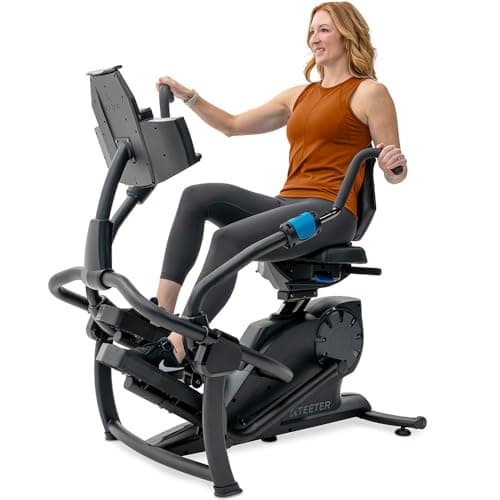
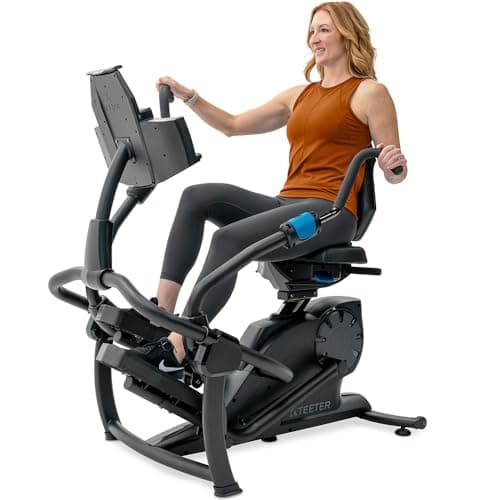
Top pick: Teeter FreeStep Recumbent Cross Trainer
The pedals travel a straight line instead of a circle — the most different joint path on this site, and the reason this is a cross-trainer, not a bike. It is also the most expensive machine we cover, so the real question is whether the stride is worth it.
How this is funded: we earn a commission if you buy through our links, at no extra cost to you. It never changes what we recommend, and every page here names at least one thing we would not buy. Full disclosure.

Knees that dislike a circular pedal stroke
Not a bike. The pedals travel in a straight line rather than a circle, which removes the knee-flexion arc that makes a circular pedal stroke uncomfortable for some arthritic knees — and Teeter publishes an electronic step lock specifically for getting on and off. Also the most expensive machine on the site.
Teeter does not publish 5 of the 10 measurements we look for. The panel below names which.
The most useful sentence anyone can tell you about the Teeter FreeStep is what it is not: it is not a bike. On every other seated machine we cover — the recumbent bikes and the recumbent cross-trainers alike — your feet travel around a circle or an ellipse. On the FreeStep, published as a linear stepping motion, the pedals push straight out and draw straight back along a line. That is the single most different joint path on this site, and it is the whole reason the machine exists.
Here is why the shape matters. A circular pedal stroke carries the knee through the same flexion arc on every revolution, including the deep part of the bend at the top of the circle — which is the part some arthritic knees object to. A straight-line step lets you decide how far the knee bends and then never forces it past that point. Movement itself is the goal the authorities keep pointing at: the Arthritis Foundation lists low-impact options such as cycling for arthritic joints, and it is clear that motion helps osteoarthritis rather than aggravating it. Which specific motion suits your knee, though, is a question for your doctor or physical therapist, not a spec sheet.
The second headline is the price. This is the most expensive machine on the entire site, by a wide margin. So the real question is not whether a straight-line stride is different — it plainly is — but whether that difference, plus the published electronic step lock and the 350 lb capacity, is worth several times what a basic recumbent bike costs.
And we will not bury the gaps. Teeter still does not publish a step-over height, a seat height, or a box weight for this machine. The physical-therapy licensing you will see mentioned is about the stride patent— not evidence that the FreeStep will treat your particular condition. We come back to both below.
Teeter does not publish 5 of 10 of these. Where that is the case, this panel says so rather than guessing. How we compile these
Source: Amazon product listing data (Creators API) · read 2026-07-24
We have not used this machine. Everything above comes from the manufacturer’s published documentation and the dated retailer listing, with the source given for each figure. Where they don’t publish a number, we say so. We can’t tell you how it feels to ride, how quiet it really is, or how it holds up after two years — and anyone who tells you otherwise without owning one is guessing.
Teeter publishes the FreeStep’s resistance in a way almost nobody else here does: in pounds. The console offers 20 levels spanning 0 to 105 lb. On a flywheel bike you spin against magnets and read an abstract level number; on the FreeStep you push against a stated load, which is a more honest description of what your legs are actually doing on a stepping machine.
That ties directly to the stride. Because the pedals move independently along their line rather than being locked to a spinning crank, each leg pushes and returns on its own — the manufacturer describes it as a stepping motion rather than a pedal stroke. For a knee that dislikes being dragged through the top of a circular arc, being able to shorten the push and stop where it is comfortable is the mechanical advantage on offer here.
None of that is a medical claim, and we are careful to keep it that way. The Arthritis Foundation explains that cycling’s continuous motion moves the joint through its range, and the FreeStep’s appeal is that it lets you control how much of that range you use. Whether it helps yourknee is between you, your doctor and — if you have one — the physical therapist who knows your history.
The FreeStep’s standout accessibility feature is one Teeter actually publishes: an Electronic Step Lock that holds the pedals still while you get on and off. On any seated machine with independent, freely moving pedals, an unweighted pedal can sink under your foot at the exact moment you are transferring your weight onto it — which is the worst possible moment for something to move. A lock that pins both pedals in place removes that.
It is a genuine, named feature rather than marketing, and it is the sort of thing this site was built to reward. But be clear about what it does and does not answer. The step lock helps you once you are already lowering yourself onto the seat. It says nothing about how high that seat sits, or how far you have to lift your foot to clear the frame — because Teeter does not publish a seat height or a step-over height for this machine.
That is not unusual; it is the norm across this whole category. Not one manufacturer we checked publishes a step-over height. If you can get to a showroom, measuring it yourself takes about a minute and answers the question the spec sheet leaves open.
The FreeStep carries a 9 in color LCD, the largest display on any machine on this site — the next biggest is the Schwinn 290’s 7-inch screen. For an audience where presbyopia is close to universal, a bigger screen is a real, practical advantage.
With one honest caveat: a big screen is not the same as big digits. Teeter does not publish the character height, so we cannot promise the numbers themselves are large — only that there is a lot of screen to put them on. Nobody in this category publishes character height, so the FreeStep is no worse than the field here; it simply is not better in a way we can prove.
As a piece of cardio equipment it is straightforward to place in a routine. The CDC recommends adults 65 and over get at least 150 minutes a week of moderate activity plus muscle-strengthening on two days, and a seated stepper with 20 load levels and the arms moving too is an easy way to bank those minutes without loading a sore knee. The machine is rated for users from 4 ft 11 in to 6 ft 6 in and up to 350 lb.
Three things count against the FreeStep, and none of them are secrets. First, the price: it is the most expensive machine on this site, several times the cost of the budget recumbent bikes that deliver the same weekly minutes of seated cardio. You are paying for the stride shape, the step lock and the build — so the value depends entirely on whether those specific things solve a specific problem for you.
Second, the footprint. At 32.7 in wide it is the widest seated machine we cover, and at 59 in long it needs a genuine floor area, plus clearance on at least one side to transfer on and off. Measure your room before you fall for the stride.
Third, and most important to get straight: you will see the FreeStep described as licensed from a physical-therapy company. That licensing is about the stride patent— the mechanism — not a clinical endorsement that the machine treats arthritis, recovers a joint, or does anything therapeutic. Do not read it as a medical claim, because it is not one. If you are shopping because of pain, a recent surgery or a fall, follow the plan your surgeon and physical therapist gave you; it outranks anything a product page — including this one — can tell you.
A knee that dislikes a circular pedal stroke.The linear step is the only seated motion on this site that lets you cap how far the knee bends, and that is the machine’s reason to exist.
Someone who wants to push against a stated load. Resistance published as 0 to 105 lb across 20 levels is more concrete than an abstract level number, and easy to nudge up a pound at a time.
A household with the room and the budget. If a 32.7 in wide, 59 in long machine fits and the price is not the deciding factor, the FreeStep is the most distinctive option here.
Anyone who values a published step lock. Holding the pedals still for entry and exit is a named, real feature, not a marketing line.
Anyone on a budget. A basic recumbent bike delivers the same seated cardio for a fraction of the price. The FreeStep only earns its cost if the stride shape specifically matters to you.
Anyone short on floor space. This is the widest seated machine on the site, and it wants clearance on a side for getting on and off.
Anyone who needs a published seat height.If “can I get on and stand back up?” is your central worry, the Sunny SF-RB420032 publishes a 20.9 to 22.4 in seat height and the FreeStep publishes none.
Anyone expecting a medical device. The physical-therapy licensing is about the stride patent. It is not a diagnosis, a prescription, or a promise.
General information, not medical advice. Tread & Tone is written by an enthusiast, not a clinician. Nobody here is a doctor, a physical therapist or a trainer, and nothing on this site has been medically reviewed. Talk to your doctor or physical therapist before starting something new, particularly after surgery, a fall, or a change in medication.
No. It is a recumbent cross-trainer. On a recumbent bike your feet travel a circle; on the FreeStep the pedals move in a straight line, which Teeter publishes as a linear stepping motion. That different joint path is the main reason to consider it over a bike — and our recumbent bike versus cross-trainer guide lays out the full comparison.
The mechanism is plausible: a straight-line step lets you control how far the knee bends and avoids being carried through the top of a circular pedal arc, which some arthritic knees dislike. The Arthritis Foundation is clear that low-impact movement helps osteoarthritis rather than aggravating it. But whether this specific motion suits your knee is a question for your doctor or physical therapist, not a spec sheet. We have not used the machine and make no medical claim.
Teeter publishes a 350 lb weight capacity and a rider-height range of 4 ft 11 in to 6 ft 6 in. It does not publish a seat height or a step-over height, so the getting-on question is only partly answered by the numbers — though the published Electronic Step Lock, which holds the pedals still during entry and exit, helps.
Through 20 levels spanning 0 to 105 lb, published in pounds rather than as abstract level numbers — unusual and useful. Because the pedals move independently along their line, each leg pushes against that stated load and returns on its own, rather than spinning a shared flywheel.
You are paying for the linear stride mechanism, the electronic step lock, the 9-inch color LCD (the largest display on this site) and the build. It is the most expensive machine we cover, by a wide margin. If the straight-line stride does not specifically solve a problem for you, a budget recumbent bike delivers the same weekly cardio minutes for far less.
No. The licensing refers to the stride patent — the mechanism — not a clinical finding that the machine treats any condition. Read it as an engineering pedigree, not a medical endorsement. If pain, surgery or a fall is the reason you are shopping, follow the protocol your surgeon and physical therapist gave you.
Product measurements are cited individually inside each Fit-to-You panel, against the manufacturer page or dated retailer listing they were read from.
Best for Arthritis
Which seated machines keep the joint moving through its range without loading it — and the one that isn't a bike at all.
Top pick: Teeter FreeStep Recumbent Cross Trainer
Best Cross-Trainer
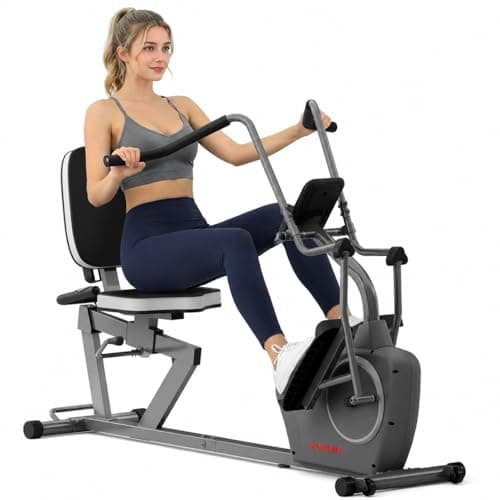
Seated ellipticals that swap the circular pedal stroke for a stepping stride — ranked on which makers publish a weight capacity and which hide it.
Top pick: VANSWE Recumbent Elliptical Cross Trainer
Both seat you with your back supported. One turns a circle, the other steps a straight line — and for some arthritic knees that single difference is the whole decision.
Read the guide