Tread & Tone

NuStep Alternatives for Home Use

NuStep publishes its own home price: $3,995 for the T4r-h. These four machines use the same linked arm-and-leg stepping motion at consumer prices — and one of them matches NuStep’s published weight capacity exactly.

By Stephen V.Last updated How we choose

How this is funded: we earn a commission if you buy through our links, at no extra cost to you. It never changes what we recommend, and every page here names at least one thing we would not buy. Full disclosure.

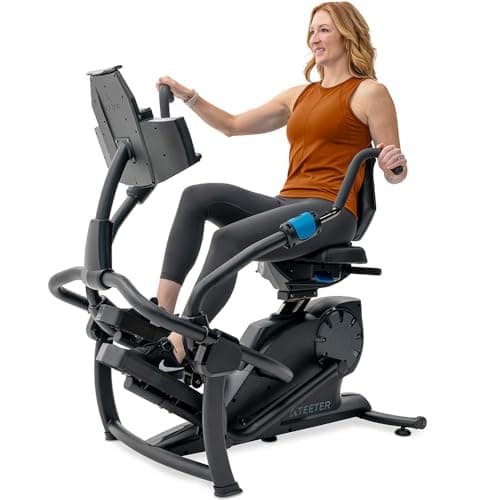
The closest alternative is the Teeter FreeStep, and it is for the reader who met a NuStep in a rehab gym and wants that specific motion at home. Its pedals travel in a straight line rather than a circle, which is the same category of movement NuStep calls a smooth stepping motion, and Teeter publishes an Electronic Step Lock that holds the pedals still while you get on and off — the direct analogue of the StrideLock feature NuStep describes as “a unique locking feature for additional stability while accessing the unit”. It also publishes resistance in actual pounds, 0 to 105 lb across 20 levels, against NuStep’s published 10 resistance levels. The budget pick is the VANSWE recumbent elliptical, which costs a small fraction of the Teeter, publishes a 400 lb weight capacity — matching NuStep’s own published 400 lb user weight capacity exactly — and publishes an inseam range and a rider-height range on top of it.

First, what a NuStep is and what it is known for, quoted from NuStep’s own material rather than from us. Its 2024 T4r flyer describes the T4r recumbent cross trainer’s “inclusive design and user-friendly features” as making it “a popular choice in a variety of settings”, and lists what those features are: “seat swivels 360-degrees”, “400 lbs. user weight capacity”, “10 resistance levels”, “low inertia start up”, “user-controlled step length”, “smooth stepping motion” and a “sturdy grab ring”. The same flyer prices both models: the T4r-h, which it says is “designed with home users in mind” with “a smaller footprint and an economical price point”, at $3,995; and the T4r, which adds StrideLock, at $4,695.

That is the honest shape of the problem. NuStep is not an overpriced consumer machine — it is institutional equipment that happens to sell a home version, and the feature list above is why clinics buy it. If you can spend four thousand dollars, buy the NuStep; nothing on this page is a NuStep. What this page is for is the far more common situation: somebody used one in cardiac rehab or physical therapy, got on with it, and wants to continue at home on a budget two or three orders of magnitude lower. The useful question is not “what is just as good”. It is which of NuStep’s published features can you actually get at a consumer price, and the answer is more of them than you would expect, with one clear exception.

The exception is the swivel seat, and we will say it plainly: not one machine on this page publishes a seat that swivels.NuStep publishes a seat that rotates through a full circle, and for a user transferring from a wheelchair or needing to get on sideways that is a genuine accessibility feature with no substitute in this registry. If a rotating seat is the reason the NuStep worked for you, no amount of money saved below will replace it, and you should go and buy a NuStep or ask your therapist about a used one. Nobody here publishes a user-settable step length either. Everything else on NuStep’s list — the stepping motion, a 400 lb capacity, published resistance levels, a locking feature for getting on — is available on this page from at least one machine.

Two general notes. The reason this motion is worth chasing at all is that it is a different joint path, not a marketing distinction: the Arthritis Foundation notes that movement helps osteoarthritis rather than aggravating it, so the aim is to keep the motion and change its shape for a knee that dislikes a circular stroke. And if you were sent to a NuStep as part of a supervised program, which machine you continue on at home is a question for the therapist who prescribed it — bring this page to them rather than instead of them.

About the price comparison: we check it rather than assert it. NuStep publishes $3,995 for its home T4r-h, and our live price read on November 12, 2026 puts 5 of the 5 machines below that figure. Prices move, ours expire by themselves after forty-eight hours, and the number in the button is always the more recent one.

Quick picks

Ranked on the published accessibility measurements and on who each machine actually suits. Select a row to jump to the full write-up. The last column is the number of the nine measurements the manufacturer will not publish — we have not used any of these machines, and here is exactly what we did instead.

#MachineBest forSpecs withheldPrice
1
Teeter FreeStep Recumbent Cross Trainer

Teeter FreeStep Recumbent Cross Trainer

Knees that dislike a circular pedal stroke

Closest to the motion5of 10
$1,449.99 · Check price on Amazon

Price as of November 12, 2026. #ad How we’re funded

2
VANSWE Recumbent Elliptical Cross Trainer

VANSWE Recumbent Elliptical Cross Trainer

The best-documented cross-trainer here

Budget pick, best documented4of 10
$359.99 · Check price on Amazon

$389.998% off

Price as of November 12, 2026. #ad How we’re funded

3
Sunny Health & Fitness Smart Recumbent Elliptical Cross Trainer for Seniors

Sunny Health & Fitness Smart Recumbent Elliptical Cross Trainer for Seniors

A published step-through entry

Published step-through9of 10
$449.99 · Check price on Amazon

Price as of November 12, 2026. #ad How we’re funded

4
Sunny Health & Fitness Smart 2-in-1 Electro-Magnetic Recumbent Elliptical

Sunny Health & Fitness Smart 2-in-1 Electro-Magnetic Recumbent Elliptical

Most guided sessions

Most guided sessions8of 10
$699.99 · Check price on Amazon

Price as of November 12, 2026. #ad How we’re funded

5
VANSWE Recumbent Elliptical Cross Trainer with Arm Exerciser

VANSWE Recumbent Elliptical Cross Trainer with Arm Exerciser

We would skip this one — see below

Only if over 400 lb4of 10
$599.99 · Check price on Amazon

Price as of November 12, 2026. #ad How we’re funded

1.Closest to the motion

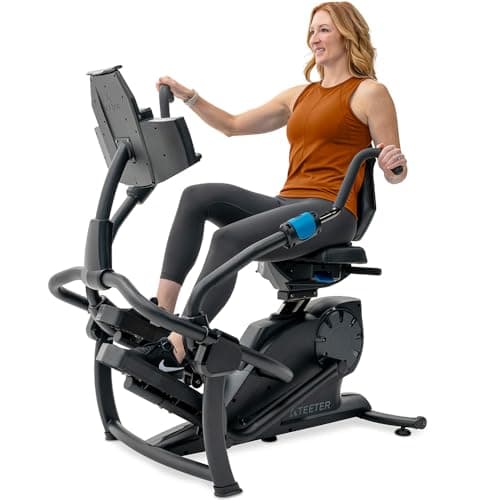
Teeter FreeStep Recumbent Cross Trainer(SE2701)
Teeter FreeStep Recumbent Cross Trainer
$1,449.99 · Check price on Amazon

Price as of November 12, 2026. #ad How we’re funded

Not a bike. The pedals travel in a straight line rather than a circle, which removes the knee-flexion arc that makes a circular pedal stroke uncomfortable for some arthritic knees — and Teeter publishes an electronic step lock specifically for getting on and off. Also the most expensive machine on the site.

What it gets right

  • Linear stepping motion rather than a circular pedal stroke — a genuinely different joint path, not a marketing distinction
  • Electronic Step Lock holds the pedals still while you get on and off, published as an accessibility feature
  • Publishes resistance in pounds (0–105 lb across 20 levels), not just level numbers
  • 9 in color LCD, the largest display anywhere on this site; published rider range 4 ft 11 in to 6 ft 6 in

What to know first

  • The most expensive machine here by a wide margin
  • 32.7 in wide and 59 in long — the largest footprint of any seated machine on this page
  • Step-over height, seat height and box weight still unpublished
  • The physical-therapy licensing claim is about the stride patent, not evidence that it will help your specific condition

Fit-to-You: the nine measurements

Teeter does not publish 5 of 10 of these. Where that is the case, this panel says so rather than guessing. How we compile these

Step-over heightThe single number that decides whether you can get on at all. Almost nobody publishes it.
Not published by the manufacturer
Seat height from floorDecides whether you sit down onto the seat or lower yourself into it, and whether you can stand back up unaided.
Not published by the manufacturer
Weight capacitySearched directly, and two of the senior-focused competitors omit it entirely.
350 lb; rated for users 4 ft 11 in to 6 ft 6 in

Source: Amazon product listing data (Creators API) · read 2026-07-24

Inseam rangeWhether the seat travels far enough for your leg length without over-extending the knee.
Not given as an inseam; stated rider height range 4 ft 11 in to 6 ft 6 in

Source: Amazon product listing data (Creators API) · read 2026-07-24

Pedal spacing (Q-factor)How far apart the pedals sit. A narrow pedal spacing reduces the sideways load on arthritic knees.
Not published by the manufacturer
Display character heightCharacter height and contrast. Presbyopia is close to universal past 60.
9 in color LCD; character height not published

Source: Amazon product listing data (Creators API) · read 2026-07-24

Controls and reachCan it be operated one-handed, by feel, while seated? This is where low-strength and low-vision buyers get stranded.
Electronic Step Lock for entry and exit; console quick-keys for 20 resistance levels (0–105 lb); height-adjustable media rack

Source: Amazon product listing data (Creators API) · read 2026-07-24

Assembly and box weightBox weight and how many people it needs. A 130 lb box is a real barrier, not a footnote.
Not published by the manufacturer
Noise (dB)Apartments, shared walls, and a sleeping partner in the next room.
Not published by the manufacturer
FootprintWhether it actually fits the room you have in mind, with clearance to get on and off.
59 in long × 32.7 in wide × 54.8 in high

Source: Amazon product listing data (Creators API) · read 2026-07-24

We have not used this machine. Everything above comes from the manufacturer’s published documentation and the dated retailer listing, with the source given for each figure. Where they don’t publish a number, we say so. We can’t tell you how it feels to ride, how quiet it really is, or how it holds up after two years — and anyone who tells you otherwise without owning one is guessing.
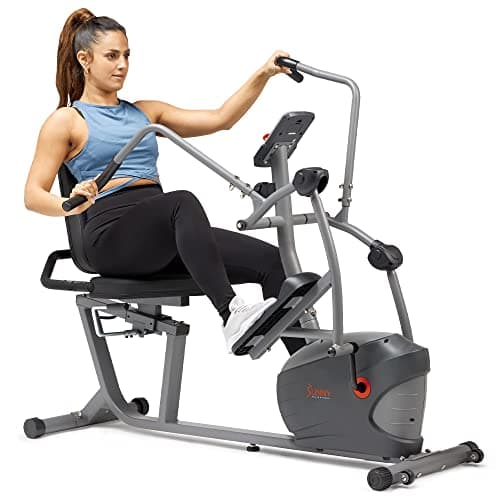
2.Budget pick, best documented

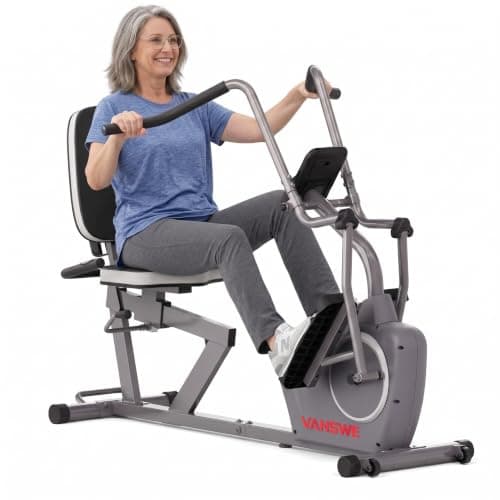
VANSWE Recumbent Elliptical Cross Trainer

VANSWE Recumbent Elliptical Cross Trainer
$359.99 · Check price on Amazon

$389.998% off

Price as of November 12, 2026. #ad How we’re funded

The one recumbent cross-trainer in this shortlist whose listing states a weight capacity, an inseam range and a rider-height range — 400 lb, 29 to 37 in, and 5 ft 2 in to 6 ft 5 in. That is more answered questions than most machines in this aisle give you, and it is why it leads. It still won't tell you the step-over height or the seat height.

What it gets right

  • Publishes a 400 lb weight capacity — a real answer to the most-searched spec in the category
  • States an inseam range of 29 to 37 in and a rider-height range of 5 ft 2 in to 6 ft 5 in, so you can tell before it arrives whether it fits you
  • Moving arm handles work the upper body alongside the legs, and the resistance is published as 8 levels of quiet magnetic resistance
  • A back-lit display, which matters more past 60 than the marketing implies

What to know first

  • Now rated 400 lb — 50 lb below the pricier VANSWE listing, and down from the 450 lb this listing stated when we first read it
  • No step-over height and no seat height, so the getting-on question is only half answered
  • Eight resistance levels, with nothing published about how light the lowest one is
  • The arm handles move with the pedals, so the listing describes no arms-off, legs-only session

Fit-to-You: the nine measurements

VANSWE does not publish 4 of 10 of these. Where that is the case, this panel says so rather than guessing. How we compile these

Step-over heightThe single number that decides whether you can get on at all. Almost nobody publishes it.
Not published by the manufacturer
Seat height from floorDecides whether you sit down onto the seat or lower yourself into it, and whether you can stand back up unaided.
Not published by the manufacturer
Weight capacitySearched directly, and two of the senior-focused competitors omit it entirely.
400 lb

Source: Amazon product listing data (Creators API) · read 2026-09-10

Inseam rangeWhether the seat travels far enough for your leg length without over-extending the knee.
29 in to 37 in on an infinite seat slider (stated rider height 5 ft 2 in to 6 ft 5 in)

Source: Amazon product listing data (Creators API) · read 2026-09-10

Pedal spacing (Q-factor)How far apart the pedals sit. A narrow pedal spacing reduces the sideways load on arthritic knees.
Not published by the manufacturer
Display character heightCharacter height and contrast. Presbyopia is close to universal past 60.
Back-lit LED display; character height not published

Source: Amazon product listing data (Creators API) · read 2026-08-03

Controls and reachCan it be operated one-handed, by feel, while seated? This is where low-strength and low-vision buyers get stranded.
8-level quiet magnetic resistance; moving arm handles; Bluetooth app

Source: Amazon product listing data (Creators API) · read 2026-09-10

Assembly and box weightBox weight and how many people it needs. A 130 lb box is a real barrier, not a footnote.
Stated 80% pre-assembled, first workout within 30 minutes, tools included; box weight not published

Source: Amazon product listing data (Creators API) · read 2026-09-10

Noise (dB)Apartments, shared walls, and a sleeping partner in the next room.
Not published by the manufacturer
FootprintWhether it actually fits the room you have in mind, with clearance to get on and off.
57 in long × 19.8 in wide × 47 in high, from the listing's dimension fields

Source: Amazon product listing data (Creators API) · read 2026-09-10

We have not used this machine. Everything above comes from the manufacturer’s published documentation and the dated retailer listing, with the source given for each figure. Where they don’t publish a number, we say so. We can’t tell you how it feels to ride, how quiet it really is, or how it holds up after two years — and anyone who tells you otherwise without owning one is guessing.
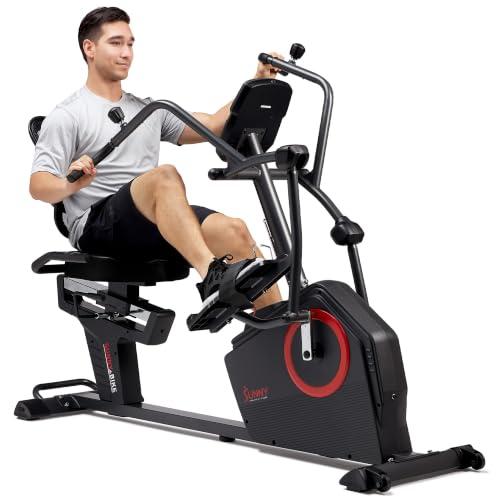
3.Published step-through

Sunny Health & Fitness Smart Recumbent Elliptical Cross Trainer for Seniors

Sunny Health & Fitness Smart Recumbent Elliptical Cross Trainer for Seniors
$449.99 · Check price on Amazon

Price as of November 12, 2026. #ad How we’re funded

The listing leads with the one word that matters most in this aisle — step-through — and backs it with 8 resistance levels and a dual-function arm-and-leg motion. What it will not tell you is the weight capacity, which is a real gap on a machine sold explicitly to seniors.

What it gets right

  • Step-through design is stated plainly, which is the single feature that decides whether a nervous buyer will use it
  • Publishes 8 resistance levels — an actual count, not just 'adjustable'
  • Dual-function motion works the arms and legs together, and pulse sensors are on the handlebars
  • Connects to the SunnyFit app if you want a session structured for you

What to know first

  • No published weight capacity — the most-searched spec in the category, and its absence is the reason it does not lead
  • No step-over height or seat height, so 'step-through' is a claim rather than a measured number
  • No assembled dimensions in the listing
  • Costs more than the VANSWE above while publishing less about who it fits

Fit-to-You: the nine measurements

Sunny Health & Fitness does not publish 9 of 10 of these. Where that is the case, this panel says so rather than guessing. How we compile these

Step-over heightThe single number that decides whether you can get on at all. Almost nobody publishes it.
Not published by the manufacturer
Seat height from floorDecides whether you sit down onto the seat or lower yourself into it, and whether you can stand back up unaided.
Not published by the manufacturer
Weight capacitySearched directly, and two of the senior-focused competitors omit it entirely.
Not published by the manufacturer
Inseam rangeWhether the seat travels far enough for your leg length without over-extending the knee.
Not published by the manufacturer
Pedal spacing (Q-factor)How far apart the pedals sit. A narrow pedal spacing reduces the sideways load on arthritic knees.
Not published by the manufacturer
Display character heightCharacter height and contrast. Presbyopia is close to universal past 60.
Not published by the manufacturer
Controls and reachCan it be operated one-handed, by feel, while seated? This is where low-strength and low-vision buyers get stranded.
Step-through design; 8 resistance levels; dual-function arm and leg motion; pulse sensors on the handlebars; SunnyFit app

Source: Amazon product listing data (Creators API) · read 2026-08-03

Assembly and box weightBox weight and how many people it needs. A 130 lb box is a real barrier, not a footnote.
Not published by the manufacturer
Noise (dB)Apartments, shared walls, and a sleeping partner in the next room.
Not published by the manufacturer
FootprintWhether it actually fits the room you have in mind, with clearance to get on and off.
Not published by the manufacturer

We have not used this machine. Everything above comes from the manufacturer’s published documentation and the dated retailer listing, with the source given for each figure. Where they don’t publish a number, we say so. We can’t tell you how it feels to ride, how quiet it really is, or how it holds up after two years — and anyone who tells you otherwise without owning one is guessing.
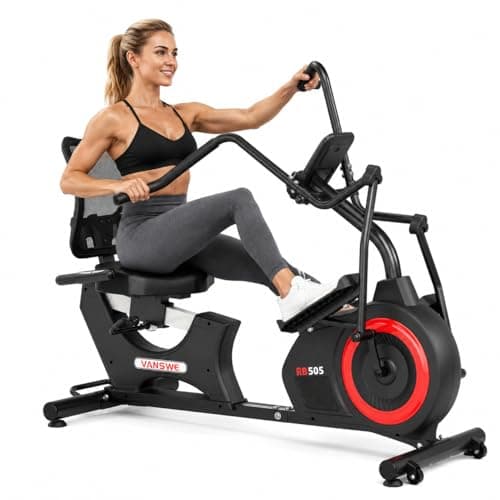
4.Most guided sessions

Sunny Health & Fitness Smart 2-in-1 Electro-Magnetic Recumbent Elliptical

Sunny Health & Fitness Smart 2-in-1 Electro-Magnetic Recumbent Elliptical
$699.99 · Check price on Amazon

Price as of November 12, 2026. #ad How we’re funded

The most guided machine here short of the Teeter: electro-magnetic resistance with 12 preset programs and 4 you can build yourself. If you want the machine to run the session rather than you, this is the one. The trade-off is a 300 lb capacity — the lowest of the cross-trainers — and the highest price of the three Sunny and VANSWE options.

What it gets right

  • Electro-magnetic resistance, which the listing pairs with 12 preset programs and 4 user programs
  • Publishes a 300 lb weight capacity — stated plainly, which two machines here do not manage
  • An 'easy access' step-through frame and SunnyFit app connectivity
  • The program count is the reason to pay more: it structures the workout so you don't have to

What to know first

  • 300 lb capacity is the lowest of the cross-trainers on this page
  • The priciest of the Sunny and VANSWE machines, for a lower capacity than the cheaper VANSWE
  • No step-over height, seat height or assembled dimensions published
  • Display character height is not published, despite the programs implying a screen

Fit-to-You: the nine measurements

Sunny Health & Fitness does not publish 8 of 10 of these. Where that is the case, this panel says so rather than guessing. How we compile these

Step-over heightThe single number that decides whether you can get on at all. Almost nobody publishes it.
Not published by the manufacturer
Seat height from floorDecides whether you sit down onto the seat or lower yourself into it, and whether you can stand back up unaided.
Not published by the manufacturer
Weight capacitySearched directly, and two of the senior-focused competitors omit it entirely.
300 lb

Source: Amazon product listing data (Creators API) · read 2026-08-03

Inseam rangeWhether the seat travels far enough for your leg length without over-extending the knee.
Not published by the manufacturer
Pedal spacing (Q-factor)How far apart the pedals sit. A narrow pedal spacing reduces the sideways load on arthritic knees.
Not published by the manufacturer
Display character heightCharacter height and contrast. Presbyopia is close to universal past 60.
Not published by the manufacturer
Controls and reachCan it be operated one-handed, by feel, while seated? This is where low-strength and low-vision buyers get stranded.
Electro-magnetic resistance; 12 preset programs plus 4 user programs; easy-access step-through frame; SunnyFit app

Source: Amazon product listing data (Creators API) · read 2026-08-03

Assembly and box weightBox weight and how many people it needs. A 130 lb box is a real barrier, not a footnote.
Not published by the manufacturer
Noise (dB)Apartments, shared walls, and a sleeping partner in the next room.
Not published by the manufacturer
FootprintWhether it actually fits the room you have in mind, with clearance to get on and off.
Not published by the manufacturer

We have not used this machine. Everything above comes from the manufacturer’s published documentation and the dated retailer listing, with the source given for each figure. Where they don’t publish a number, we say so. We can’t tell you how it feels to ride, how quiet it really is, or how it holds up after two years — and anyone who tells you otherwise without owning one is guessing.
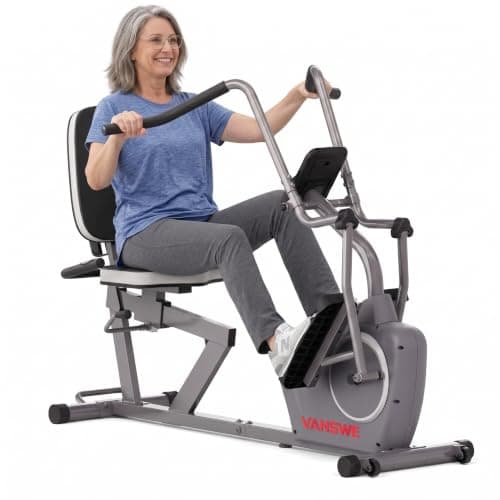
5.We would skip this one

VANSWE Recumbent Elliptical Cross Trainer with Arm Exerciser

VANSWE Recumbent Elliptical Cross Trainer with Arm Exerciser
$599.99 · Check price on Amazon

Price as of November 12, 2026. #ad How we’re funded

A second VANSWE cross-trainer listing that now differs from the cheaper one in a single documented way that matters: a 450 lb capacity against 400 lb. For a rider over 400 lb that settles it; for everyone else it is the same kind of machine at a higher price, with a narrower stated fit.

Why we would skip it

We would skip this listing unless you weigh more than 400 lb. The two VANSWE cross-trainer listings used to read line for line the same; they no longer do. This one now states 450 lb against the cheaper listing's 400 lb, and that 50 lb is the only documented reason to pay more — it typically lists well above the cheaper one, publishes no inseam range, and its stated rider height stops at 6 ft 3 in rather than 6 ft 5 in. Under 400 lb, buy the cheaper listing. Over it, this is the one of the two whose rating covers you.

What it gets right

  • Publishes a 450 lb weight capacity — 50 lb more than the cheaper VANSWE listing now states
  • Publishes a rider-height range, 8 magnetic resistance levels on a belt drive, and its assembled dimensions

What to know first

  • Typically priced well above the cheaper VANSWE listing
  • Stated rider height stops at 6 ft 3 in, two inches short of the cheaper listing's 6 ft 5 in, and no inseam range is given
  • At 25 in wide it takes about five more inches of floor width than the cheaper listing
  • No step-over height or seat height, the same gaps as every cross-trainer here

Fit-to-You: the nine measurements

VANSWE does not publish 4 of 10 of these. Where that is the case, this panel says so rather than guessing. How we compile these

Step-over heightThe single number that decides whether you can get on at all. Almost nobody publishes it.
Not published by the manufacturer
Seat height from floorDecides whether you sit down onto the seat or lower yourself into it, and whether you can stand back up unaided.
Not published by the manufacturer
Weight capacitySearched directly, and two of the senior-focused competitors omit it entirely.
450 lb

Source: Amazon product listing data (Creators API) · read 2026-09-10

Inseam rangeWhether the seat travels far enough for your leg length without over-extending the knee.
Not given as an inseam; slide-rail seat stated to fit riders 5 ft 2 in to 6 ft 3 in

Source: Amazon product listing data (Creators API) · read 2026-09-10

Pedal spacing (Q-factor)How far apart the pedals sit. A narrow pedal spacing reduces the sideways load on arthritic knees.
Not published by the manufacturer
Display character heightCharacter height and contrast. Presbyopia is close to universal past 60.
LCD monitor; character height not published

Source: Amazon product listing data (Creators API) · read 2026-09-10

Controls and reachCan it be operated one-handed, by feel, while seated? This is where low-strength and low-vision buyers get stranded.
8-level magnetic resistance on a belt drive; moving arm handles; Bluetooth app

Source: Amazon product listing data (Creators API) · read 2026-09-10

Assembly and box weightBox weight and how many people it needs. A 130 lb box is a real barrier, not a footnote.
Stated setup time of 45 to 60 minutes with pre-assembled parts; box weight not published

Source: Amazon product listing data (Creators API) · read 2026-09-10

Noise (dB)Apartments, shared walls, and a sleeping partner in the next room.
Not published by the manufacturer
FootprintWhether it actually fits the room you have in mind, with clearance to get on and off.
59 in long × 25 in wide × 47 in high, from the listing's dimension fields

Source: Amazon product listing data (Creators API) · read 2026-09-10

We have not used this machine. Everything above comes from the manufacturer’s published documentation and the dated retailer listing, with the source given for each figure. Where they don’t publish a number, we say so. We can’t tell you how it feels to ride, how quiet it really is, or how it holds up after two years — and anyone who tells you otherwise without owning one is guessing.
What we found looking for these numbers

We went looking for 50 measurements across the 5machines on this page — the nine that decide whether an older adult can get on, reach the controls, read the screen and hear themselves think. 30 of those 50 are not published by anybody. Not one manufacturer here publishes the full set.

Step-over height is the worst of them. It is the single measurement that decides whether you can get onto a machine at all, and across everything we checked, not one manufacturer states it. That is not an oversight in a category explicitly marketed to seniors, and the count in each panel above is there so you can see who is doing it.

Where a figure exists, we cite it and date it. Where it doesn’t, the panel says Not published by the manufacturer rather than an estimate dressed up as a fact. You can measure step-over height yourself in about a minute — and if a machine is already in your house, that is the fastest way to settle it.

The motion, and the machine that matches it closest

NuStep’s flyer calls it a “smooth stepping motion” with “low inertia start up”, and those two phrases together describe the thing people remember about using one: your feet travel a path rather than a circle, and the machine does not fight you at the beginning of the stroke. The Teeter FreeStep is the machine in this registry that gets closest, and the published reason is specific. Its pedals travel in a straight line rather than a circle, which removes the knee-flexion arc that makes a circular pedal stroke uncomfortable for some arthritic knees. That is a genuinely different joint path, not a variation on a bike.

It matches NuStep on two more published features. NuStep lists StrideLock, “a unique locking feature for additional stability while accessing the unit”; Teeter publishes an Electronic Step Lock that holds the pedals still while you get on and off, stated as an accessibility feature. And where NuStep publishes 10 resistance levels, Teeter publishes 20 levels and — unusually for anything in this category — states them in pounds, 0 to 105 lb, so the setting means something rather than being a number on a dial. It adds a 9 inch color LCD, the largest display on this site, a published 350 lb capacity and a published rider range of 4 ft 11 in to 6 ft 6 in.

Where it falls short of NuStep is worth stating precisely rather than glossing. Its published 350 lb capacity is below NuStep’s published 400 lb. It publishes no swivel seat and no user-settable step length. At 59 inches long and 32.7 inches wide it has the largest footprint of any seated machine we track, which matters because NuStep’s own pitch for the home model is a smallerfootprint. And its physical-therapy licensing claim is about the stride patent rather than evidence it will help your specific condition — we say that on its own review page too. It is also the most expensive machine on this site by a wide margin, which is the honest reason the budget pick sits directly beneath it.

The capacity match, at a fraction of the price

The VANSWE recumbent elliptical is the budget pick and it does something no other machine here manages: it publishes a 400 lb weight capacity, which is exactly the figure NuStep publishes. If capacity is why the NuStep was recommended to you — and in a rehab setting it very often is — then the most relevant specification on this page is matched by the cheapest machine on it. It is also the best-documented cross-trainer in this registry: a published 29 to 37 inch inseam range on an infinite seat slider, a published rider-height range of 5 ft 2 in to 6 ft 5 in, moving arm handles that work the upper body alongside the legs, 8 levels of quiet magnetic resistance, and a back-lit display.

The moving arm handles are the part that matters for a NuStep comparison. A NuStep’s defining motion is the arms and legs working together, and the VANSWE publishes that. What it does not publish is any way to use the legs withoutthe arms: the handles move with the pedals, so no arms-off, legs-only session is described. Its other honest gaps are that its capacity is now rated 400 lb where this same listing stated 450 lb when we first read it, that eight resistance levels are published with nothing said about how light the lowest one is, and that no step-over height or seat height is published — which is true of every cross-trainer here. Our full VANSWE review goes through every field.

The Sunny recumbent cross-trainer is third and it is on this page for one word its listing leads with: step-through. That is the single feature that decides whether a nervous buyer will actually use a machine, and Sunny states it plainly where most makers imply it. It backs that with 8 published resistance levels, a dual-function arm-and-leg motion, pulse sensors on the handlebars and SunnyFit app connectivity. The reason it is third rather than second is a real gap: it publishes no weight capacity at all, which on a machine sold explicitly to older adults is the most-searched number in the category, and it costs more than the VANSWE above it while publishing less about who it fits. “Step-through” is a claim rather than a measured number; nobody in this category publishes a step-over height.

If you want the machine to run the session, and the one to skip

The Sunny 2-in-1 recumbent elliptical is the most guided machine here short of the Teeter: electro-magnetic resistance with twelve preset programs and four you can build yourself, an “easy access” step-through frame and app connectivity. If part of what you liked about a supervised rehab session was that somebody else decided what happened next, that program count is the closest consumer substitute for it. Its published costs are a 300 lb capacity — the lowest of the cross-trainers here and a hundred pounds below NuStep’s figure — a price above the cheaper VANSWE for less capacity, and no published step-over height, seat height or assembled dimensions despite the programs implying a screen.

The VANSWE “plus” listing carries our skip label with one exception written into it: skip it unless you weigh more than 400 lb. The two VANSWE cross-trainer listings used to read line for line the same; they no longer do. This one now publishes 450 lb against the cheaper listing’s 400 lb, and that 50 lb is the only documented reason to pay more. It typically lists well above the cheaper one, it publishes no inseam range, its stated rider height stops at 6 ft 3 in rather than 6 ft 5 in, and at 25 inches wide it needs about five more inches of floor width. Under 400 lb, buy the cheaper listing. Over it — and note that this is the only machine on this page rated above NuStep’s published 400 lb — this is the one of the two whose rating covers you, and that settles it regardless of price.

To put the whole page in one paragraph: the stepping motion, the arm-and-leg linkage, a locking feature for getting on and a 400 lb capacity are all available here for consumer money. The swivel seat, the user-controlled step length and the institutional build are not available here at all. Decide which of those two lists contains your reason for wanting a NuStep, and the answer follows. We rank this whole aisle on published documentation rather than on brand resemblance on our recumbent cross-trainer shortlist, and we compare the stepping motion against an ordinary recumbent bike in recumbent bike versus cross-trainer.

General information, not medical advice. Tread & Tone is written by an enthusiast, not a clinician. Nobody here is a doctor, a physical therapist or a trainer, and nothing on this site has been medically reviewed. Talk to your doctor or physical therapist before starting something new, particularly after surgery, a fall, or a change in medication.

Questions people ask

What is a cheaper alternative to a NuStep?

The Teeter FreeStep is the closest match to the motion, and the VANSWE recumbent elliptical is the cheapest machine that matches NuStep's published 400 lb user weight capacity exactly. NuStep publishes $3,995 for its home T4r-h and $4,695 for the T4r in its own 2024 flyer, so the gap is large in both cases — the live price in each button below is the current figure for these machines. What none of them publishes is NuStep's 360-degree swivel seat, which has no substitute in this registry.

What exercise equipment is similar to a NuStep?

A recumbent cross-trainer, sometimes sold as a recumbent elliptical or a seated stepper. The shared idea is that you sit with your back supported while your feet travel a path rather than a circle, and your arms work through moving handles at the same time — NuStep's flyer calls this a smooth stepping motion with user-controlled step length. Four such machines are in our registry, ranked on this page. A recumbent exercise bike is not the same thing: the pedals travel a circle, which is the specific motion a cross-trainer exists to avoid.

How much does a NuStep cost?

NuStep publishes the figures itself in its 2024 T4r flyer: $3,995 for the T4r-h, which it describes as designed with home users in mind with a smaller footprint and an economical price point, and $4,695 for the T4r, which adds StrideLock — "a unique locking feature for additional stability while accessing the unit". We take those numbers from NuStep's own document rather than from a reseller. Used and remanufactured units exist through third parties; we do not track their prices and cannot tell you what one costs today.

What does a NuStep do that cheaper machines do not?

Three things from its own published feature list have no match in this registry. The seat swivels 360 degrees, which matters a great deal if you transfer from a wheelchair or need to get on sideways — not one machine on this page publishes a swivel seat. The step length is user-controlled, which nobody here publishes either. And it is institutional equipment designed for a clinic's duty cycle rather than a spare bedroom's. If any of those is your reason for wanting one, the saving below will not replace it.

Which NuStep alternative has the highest weight capacity?

The VANSWE recumbent elliptical 'plus' listing publishes 450 lb, which is the only figure on this page above NuStep's published 400 lb — and it is the reason that listing is on the page at all, since under 400 lb the cheaper VANSWE listing publishes more about who it fits for less money. The cheaper VANSWE publishes 400 lb, matching NuStep exactly. The Teeter publishes 350 lb and the Sunny 2-in-1 publishes 300 lb. The Sunny recumbent cross-trainer publishes no capacity at all, which is why it is third rather than second.

Can I use a recumbent cross-trainer for cardiac rehab or physical therapy at home?

Continuing a prescribed program at home is a question for the therapist who prescribed it, and the machine you continue on is part of that question — so bring the published specifications to your next appointment rather than deciding from a shortlist. What we can tell you is which published features the home machines share with the clinical one: the stepping motion, the linked arm-and-leg action, published resistance levels, and on the Teeter a published step lock for getting on and off. Our stroke-recovery and cardiac-rehab shortlists go through the same registry against those specific needs.

Is the Teeter FreeStep the same thing as a NuStep?

No, and we would not want to imply it. They share the most important design idea — a seated position with the pedals travelling in a line rather than a circle, worked by the arms and legs together — and Teeter publishes an Electronic Step Lock that does the same job NuStep's StrideLock describes. Teeter publishes more resistance detail (20 levels stated in pounds, 0 to 105 lb, against NuStep's published 10 levels). NuStep publishes a higher capacity (400 lb against 350 lb), a 360-degree swivel seat and a user-controlled step length, none of which Teeter publishes.

Sources

  • NuStep — T4r / T4r-h Recumbent Cross Trainers product flyer (FLYER_024, nustep.com) — NuStep's own flyer for its recumbent cross trainers states "seat swivels 360-degrees", "400 lbs. user weight capacity", "10 resistance levels", "low inertia start up", "user-controlled step length", "smooth stepping motion" and a "sturdy grab ring"; it prices the home model at $3,995 — "Designed with home users in mind, the T4r-h has a smaller footprint and an economical price point" — and the T4r, which adds StrideLock, "a unique locking feature for additional stability while accessing the unit", at $4,695 (read November 7, 2026)
  • Arthritis Foundation — Biking is Great for Your Joints — Cycling's continuous motion moves the joint through its range, which produces the synovial fluid that lubricates it (read July 24, 2026)
  • Arthritis Foundation — Benefits of Exercise for Osteoarthritis — Why movement helps osteoarthritis rather than aggravating it (read July 24, 2026)
  • National Institute on Aging — Exercising With Chronic Conditions — "Almost anyone, at any age, can do some type of physical activity, even with a chronic condition"; riding a bike is listed among the moderate-intensity activities that are safe for most people if built up slowly. For arthritis: low-impact activity, and "When done safely, being physically active with arthritis shouldn't make the disease or pain worse." For chronic pain: listen to your body and avoid overexercising on good days. For osteoporosis: weight-bearing exercise, plus muscle-strengthening and balance work (read October 5, 2026)
  • CDC — Older Adult Activity: An Overview — At least 150 minutes a week of moderate-intensity activity, 2 days of muscle strengthening, plus balance activities for adults 65 and over (read July 24, 2026)

Product measurements are cited individually inside each Fit-to-You panel, against the manufacturer page or dated retailer listing they were read from.

Read next