How Often Should Seniors Exercise?
The CDC's weekly numbers turned into a realistic week, how many days of cardio, strength and balance to aim for, and why little-and-often beats one long push.
Read the guideWalking, if you can only do one thing. But the honest answer is that there are four kinds of exercise and they are not interchangeable — and one question tells you which one you are missing.
How this is funded: we earn a commission if you buy through our links, at no extra cost to you. It never changes what we recommend, and every page here names at least one thing we would not buy. Full disclosure.
The short answer
If you only do one thing, walk — it is weight-bearing, it needs nothing, and it is the activity most people over 70 want to keep. But the question has no single answer, because the National Institute on Aging describes four types of exercise — endurance, strength, balance and flexibility — and they do different jobs. The useful question is not “what is best”; it is what has already started to go. Answer that and the exercise picks itself.
Every page that answers this question names one activity. Walking, or swimming, or tai chi. The naming is the problem: it treats exercise as a single thing with a leaderboard, when it is four separate capacities that decline separately and have to be maintained separately.
So this page is not a leaderboard. It is a triage. Four types, what each one actually protects, how to tell which you are short of, and what — if anything — you need to buy.
Endurance.Walking, cycling, swimming, dancing — anything that raises your breathing and holds it there. This is the one the official guidance counts in minutes: the CDC asks older adults for at least 150 minutes a week of moderate activity, with the explicit rider that some is better than none. It protects the stamina to do a full day.
Strength.Two days a week in the CDC’s guidance, and the one most often skipped. It protects the specific abilities that quietly disappear: standing up from a low chair without pushing off, carrying a bag of shopping, getting up off the floor. No amount of walking does this.
Balance. The cheapest to train and the highest-stakes. The CDC reports that more than one in four adults 65 and older falls each year. Balance is the type that protects against the single event most likely to end independent living, and it takes two minutes a day with nothing but a kitchen counter.
Flexibility. The least glamorous and the most immediately noticeable. Reaching a top shelf, turning to look behind you while reversing a car, putting socks on while seated. It is trained in minutes, not hours, and it responds quickly.
Forget what you should be doing and ask instead: what have I stopped doing?Not stopped enjoying — stopped. The answer maps almost perfectly onto which type you are short of.
If several of those are true, do them in this order: balance, strength, endurance, flexibility. That order is not about importance in the abstract — it is about how quickly losing each one costs you something irreversible.
Honestly: for three of the four types, nothing. Balance work needs a counter to steady yourself on. Flexibility needs a chair. Strength can start with your own body weight, sitting to standing from a dining chair, repeated.
Equipment buys exactly two things, and they are worth being clear about because they are the only two honest reasons to spend money here:
| Machine | Weight capacity | Controls and reach | Footprint |
|---|---|---|---|
| Sunny Health & Fitness Treadmill with Extended Safety Handrails, Low Deck | Not published by the manufacturer | Console with larger, easier-to-press buttons; pulse sensors; safety clip | 62.6 in long × 30.5 in wide × 48.8 in high |
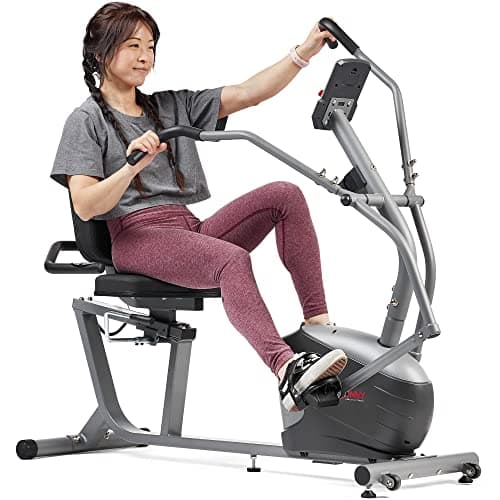
| Sunny Health & Fitness Smart Recumbent Bike with Dual-Motion Arm Exercisers | 265 lb | Pulse sensors on the stationary handlebars; seat adjusts forward and back; no one-handed operation claim made | 63.8 in long × 26.4 in wide × 49.6 in high |
Notice that the treadmill does not publish a weight capacity at all, at the highest price of any walking machine we track, and neither machine publishes the height of the thing you have to step over or onto. Measuring that yourself takes a minute and is the first thing we would do on delivery.
Flexibility is the type that gets skipped hardest, and it is the only one of the four where the payoff is immediate rather than cumulative. Nobody notices their endurance improving in week one. Everybody notices being able to turn their head further when reversing the car.
It is also the one that needs no plan. Three things, done while the kettle boils:
Two rules for all three. Hold, do not bounce — a held stretch is the version that changes range. And go to the point of mild tension, never to pain; if you are gritting your teeth you are training your body to resist the movement rather than allow it.
That is the whole flexibility requirement for most people, and it fits in the time it takes to make tea. Our warm-up and cool-down guide covers where it sits around the rest of a session.
Starting at the volume you managed twenty years ago. The NIA is clear that the benefits of activity remain available at any age; what changes is the sensible rate of progression. A 70-year-old who walks for 45 minutes on day one because that used to be easy spends days two through five sore, concludes exercise hurts now, and stops. The same person walking 12 minutes a day for a fortnight and then 15 is still going at Christmas.
The rule that works: add minutes before you add effort, and judge by tomorrow morning rather than by the session.And talk to your doctor before starting something new, particularly if you have a condition that affects your heart, lungs or joints — nobody here is a clinician and nothing on this site has been medically reviewed.
Related reading: how often seniors should exercise covers the frequency question properly, balance exercises for seniors is the two-minutes-a-day part, and our equipment guide for over-80s is the version of this page written for a tighter constraint set.
General information, not medical advice. Tread & Tone is written by an enthusiast, not a clinician. Nobody here is a doctor, a physical therapist or a trainer, and nothing on this site has been medically reviewed. Talk to your doctor or physical therapist before starting something new, particularly after surgery, a fall, or a change in medication.
If you can genuinely only do one thing, walking — it is weight-bearing, it needs no equipment, and it is the activity most people over 70 want back. But the National Institute on Aging describes four types of exercise rather than one: endurance, strength, balance and flexibility, and it is explicit that each does something the others do not. The practical answer is walking plus two minutes of balance work a day, which takes almost no extra time and addresses the thing most likely to end your independence.
The CDC's figure for older adults is at least 150 minutes a week of moderate-intensity activity, plus muscle-strengthening work on two days, plus balance work — and it adds that some activity is better than none if that total is out of reach. 150 minutes sounds like a lot until you divide it: just over 20 minutes a day, and it counts in pieces as small as you like. Our page on how often seniors should exercise breaks down how people actually reach it.
It is the best single thing, and it is not enough on its own — that is the uncomfortable part. Walking builds endurance and loads bone, and it does very little for upper-body strength, almost nothing for flexibility, and surprisingly little for balance, because walking in a straight line on a flat floor does not challenge balance the way standing on one leg does. If walking is all you will do, the highest-value addition is two minutes of balance work, not more walking.
Then endurance comes from a seated machine rather than from walking, and that changes the equipment question rather than the answer. A recumbent bike or a pedal exerciser gives you continuous cardio work with your weight in a seat, and both let you stop instantly. Strength work can be done entirely seated with light dumbbells or bands, and balance work can start sitting — reaching outside your base while seated is a genuine balance exercise. Our equipment guide for over-80s is built on exactly this constraint.
No, and the NIA's framing is the useful one: the benefits of physical activity are available at any age, and the four types of exercise all remain trainable. What changes with age is the sensible rate of progression, not whether progression happens. The specific mistake to avoid is starting at the volume you managed at 50 — that is how people get injured in week two and conclude it was the age rather than the jump.
No. Walking, chair-based strength work using your own body weight, and standing balance drills beside a kitchen counter cover three of the four types and cost nothing. Equipment buys you two things: weather independence, which is the reason most people over 70 eventually buy a machine, and the ability to work at a load your joints accept rather than the load gravity imposes. Buy for a constraint you actually have, not for completeness.
Product measurements are cited individually inside each Fit-to-You panel, against the manufacturer page or dated retailer listing they were read from.
The CDC's weekly numbers turned into a realistic week, how many days of cardio, strength and balance to aim for, and why little-and-often beats one long push.
Read the guideWhat 'low-impact' actually means, the five kinds of gear that deliver it, and how to pick the one that fits your joints, your balance and your room.
Read the guideSix exercises from the National Institute on Aging, in order of difficulty, with a printable one-page version to keep by the counter.
Read the guideBest Machine Overall
One pick from each of the four categories, with the published accessibility numbers side by side — and a plain answer to what to buy first.
Top pick: Sunny Health & Fitness Smart Recumbent Bike with Dual-Motion Arm Exercisers
Where to start when you're starting over — the one $37 purchase almost everyone should make first, and why the biggest machine is rarely the right one.
Read the guidePast 80 the constraint is rarely fitness — it is getting onto the thing, holding onto it, and standing long enough to use it. Which published specifications those three point at.
Read the guide