Seated Exercises for Limited Mobility
Eight movements you can do from a dining chair, and where equipment genuinely adds something rather than just costing money.
Read the guideOur answer is a pedal exerciser used from the chair somebody already sits in — because past 80 the equipment that gets used is the equipment that removes the transfer, not the equipment with the best specifications.
How this is funded: we earn a commission if you buy through our links, at no extra cost to you. It never changes what we recommend, and every page here names at least one thing we would not buy. Full disclosure.
The short answer
A pedal exerciser, used from the chair the person already sits in. Past 80 the limiting factor is rarely fitness — it is transfer (getting onto the thing), grip (operating it), and standing tolerance (staying on it). A pedal exerciser scores on all three by removing the transfer entirely. If the person can still walk through a frame and sit down onto a seat, a recumbent bike with a published seat height is the step up. If they can still walk outdoors comfortably, keep doing that and buy balance equipment instead.
This page exists because the usual advice does not survive contact with the question. Our own main equipment guide ranks machines on the measurements that decide whether a 60-something can use them, and it is the right page for most people. Past 80 the filter changes shape: the product list is mostly the same, but the order comes out differently, and two whole categories drop off it.
What follows is the constraint set, in the order it usually binds.
Everything else is downstream of this. If getting onto a machine is a two-minute project involving furniture and a plan, it will be used twice.
Rank the categories on transfer alone and the order is unambiguous:
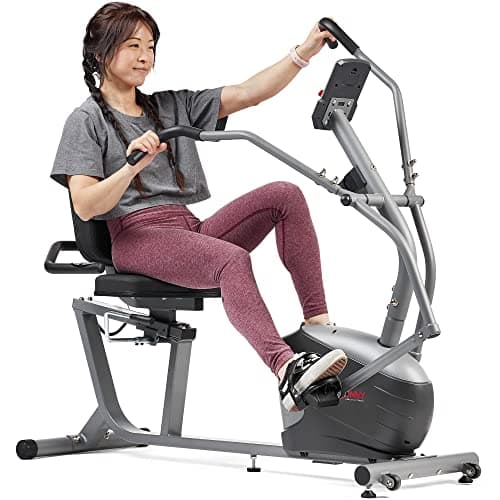
One published number does the work here, and almost nobody gives it. The Sunny SF-RB420032 publishes a seat height of 20.9 to 22.4 inches — dining-chair height, which means you sit down onto it rather than lowering into it. It is the only bike on this site that publishes a seat height at all, which tells you something about how seriously this category takes its own buyer. For every other machine, the honest route is measuring it on delivery.
This one is almost completely absent from product marketing, and it decides usability more often than weight capacity does. Three specific things to check:
How is the resistance set? A knob you turn with a loose hand is better than a lever you have to squeeze, which is better than a touchscreen that needs a precise, dry fingertip.
How is the seat adjusted? Most recumbent bikes use a two-handed pull-pin reached by bending down. The HARISON HR-B51A publishes a one-hand sliding rail worked from the seated position, and the Marcy NS-1201R publishes a quick-release lock its listing says can be set while you are sitting on it. Those are the two mechanisms that do not assume two strong hands.
Can the buttons be found without looking closely?The Sunny extended-handrail treadmill publishes a console designed with larger, easier-to-press buttons. Across the whole site, not one machine publishes a display character height, which is a remarkable gap in a category sold to this age group — so the only honest proxies are the physical panel sizes, which is why the table below reports those.
The question is not “can you stand” but “for how long, and what happens at the end of it”. Somebody who can stand for three minutes comfortably can do balance work — three minutes is more than a daily balance routine needs. Somebody for whom standing is itself the effort needs their cardio to happen sitting down.
The CDC’s guidance for adults with disabilities and chronic conditions is the right framing for this end of the range: be as active as your abilities allow, and some activity is better than none. That is not a lowered bar. It is an accurate one.
The National Institute on Aging is also worth reading before buying anything, because the leading reason to exercise at this age is not fitness in the abstract — it is the strength and balance that reduce fall risk, and a fall past 80 is the event most likely to change everything else.
| Machine | Pedal height | Seat height from floor | Weight capacity | Controls and reach |
|---|---|---|---|---|
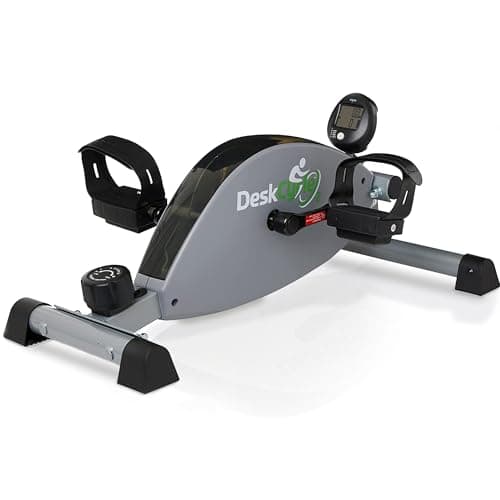
| DeskCycle DeskCycle 2 Under Desk Bike | Adjustable 9 in to 10 in; stated to fit desks as low as 27 in | Not applicable to this machine | Not published by the manufacturer | Not applicable to this machine |
| Sunny Health & Fitness Smart Recumbent Bike with Dual-Motion Arm Exercisers | Not applicable to this machine | 20.9 in minimum, 22.4 in maximum | 265 lb | Pulse sensors on the stationary handlebars; seat adjusts forward and back; no one-handed operation claim made |
| HARISON Recumbent Exercise Bike, 450 lb capacity | Not applicable to this machine | Not published by the manufacturer | 450 lb | One-hand sliding seat rail, adjustable without bending or pulling; 16-level resistance on a knob |
Two findings in that table worth stating plainly. The pedal exerciser is the only one of the three that publishes the height of the thing you have to get your feet over, and it is the only one that does not publish a weight capacity — because nothing of your weight sits on it. And two of the three publish nothing about how readable their displays are.
Standing balance boards.Foam pads and wobble cushions are the best value on this site and we recommend them constantly — but a rigid wooden wobble board is a different thing. The one in our registry carries a listing warning that it must not be used on a smooth or wet floor, and it tilts on a fixed dome, which is a genuine step up in difficulty. Past 80, start on a foam pad at a counter and progress only with somebody watching. Our balance-board shortlist is explicit about which one not to start on.
Anything requiring assembly, bought by the person who will use it. This sounds like a footnote and it is not. Several machines here arrive as a 90 lb carton of parts. The Sunny SF-RB424006 publishes a 76 lb shipping weight; the Horizon 5.0 R ships in a 66.5 inch carton. Arrange the assembly before you order, or buy one of the units that states it arrives ready to use.
And the general caution that belongs on every page like this: talk to a doctor or physiotherapist before starting something new, particularly where heart, lungs, balance or a recent fall are involved. Nobody here is a clinician and nothing on this site has been medically reviewed.
Related reading: seated exercises for limited mobility is the no-equipment version of this page, buying equipment for an aging parent covers the same decision from the other side of the family, and the best exercise over 70 is this question with a looser constraint set.
General information, not medical advice. Tread & Tone is written by an enthusiast, not a clinician. Nobody here is a doctor, a physical therapist or a trainer, and nothing on this site has been medically reviewed. Talk to your doctor or physical therapist before starting something new, particularly after surgery, a fall, or a change in medication.
For most people, a pedal exerciser used from a chair they already sit in — because the thing that decides whether equipment gets used past 80 is almost never its specifications, it is whether getting onto it is a project. A pedal exerciser removes the transfer entirely: it sits on the floor in front of an existing armchair. The DeskCycle 2 is the only one that publishes its pedal height as a range (9 to 10 in), which is the number that decides whether your knees clear the furniture.
Often yes, and the deciding question is the transfer rather than the pedalling. A recumbent is step-through, your weight is in the seat and you cannot fall off one — all genuinely suitable. What has to be checked first is whether the person can walk through the frame and lower themselves onto the seat unaided. The Sunny SF-RB420032 is the only bike on this site that publishes a seat height (20.9 to 22.4 in, roughly dining-chair height), which makes it the only one you can assess before it arrives.
Only with a very clear-eyed look at balance, and ideally after asking a physiotherapist. A treadmill moves the ground under you, which means a stumble is a fall onto a moving surface, and it requires stepping up onto a deck while taking your full weight on one leg. For someone steady on their feet who already walks outdoors, a low-deck treadmill with rails alongside can be a reasonable buy. For anyone who holds furniture when turning around, it is the wrong category and a seated machine does the same job without the risk.
The official figure does not change with age — the CDC asks older adults for at least 150 minutes a week of moderate activity plus strength and balance work — but the sentence that matters more at this end is the CDC's own rider for adults with chronic conditions or disabilities: some physical activity is better than none, and you should be as active as your abilities allow. Five minutes of pedalling twice a day is a real intervention. A plan that requires 30 unbroken minutes mostly is not.
It is the constraint that most often decides which machine is usable and the one almost nothing is designed around. The things to look for: resistance set by a knob rather than a lever that needs squeezing, a seat adjustment that works with one hand rather than a two-handed pull-pin, and controls on a flat panel with large buttons rather than a touchscreen. The HARISON HR-B51A publishes a one-hand sliding seat rail; the Sunny extended-handrail treadmill publishes a console designed with larger, easier-to-press buttons.
That is a question with a person-specific answer, and the honest framing is that it depends on what happens if something goes wrong rather than on the exercise itself. The practical mitigations are a phone within arm's reach rather than across the room, something solid to hold near the equipment that is not the equipment, and letting somebody know when a session is happening. If a fall while alone is the specific worry, a fall-detection device is a separate purchase that addresses it directly.
Product measurements are cited individually inside each Fit-to-You panel, against the manufacturer page or dated retailer listing they were read from.
Eight movements you can do from a dining chair, and where equipment genuinely adds something rather than just costing money.
Read the guideBest Machine Overall
One pick from each of the four categories, with the published accessibility numbers side by side — and a plain answer to what to buy first.
Top pick: Sunny Health & Fitness Smart Recumbent Bike with Dual-Motion Arm Exercisers
Best Pedal Exerciser
Pedal height is the spec that decides whether your knees hit the desk, and exactly one manufacturer publishes it as a range.
Top pick: DeskCycle DeskCycle 2 Under Desk Bike
Price as of October 11, 2026. #ad How we’re funded
How to buy something a parent will actually use rather than resent — starting with the measurements that decide whether they can get on it at all.
Read the guideWhich chair to use — and it matters more than the exercises — followed by a routine that takes twelve minutes.
Read the guideThere is no single best one, and anybody who names one is selling something. The four types the NIA lists, and the one question that picks between them: what has already stopped you?
Read the guide