A Recumbent Bike Workout Plan for Seniors
A four-week plan that starts shorter than feels worthwhile and builds to the CDC's weekly target, with the seat setting that decides whether it helps or hurts.
Read the guideAn honest answer for older riders: what a seated bike can and cannot do for your weight, why the kitchen matters more than the console, and how to get the most out of the sessions you do.
The short answer
Yes, a recumbent bike can help — but weight loss is mostly about what you eat, and exercise is the supporting act. A seated bike burns modest energy, preserves muscle, and is gentle enough that you will actually keep riding. Consistency beats intensity. Talk to your doctor before starting something new.
It is a fair question and it deserves a straight answer rather than a sales pitch. A recumbent bike can absolutely be part of losing weight, but it is not a weight-loss machine, and no machine is. The honest picture is quieter than the marketing on the box: the bike is a supporting player in a story that is mostly written in the kitchen. What it does genuinely well is make movement gentle enough that you will keep doing it, week after week, and that steadiness is worth more than any single hard session. Here is what a seated bike can and cannot do for your weight, and how to get the most out of the sessions you actually do.
A recumbent bike can help you manage your weight, but the larger truth is that weight loss is driven far more by what and how much you eat than by any exercise you do. That is not a knock on the bike — it is simply how the arithmetic works out for most people. You can pedal conscientiously and still not move the scale if the eating side is not part of the plan. So the first honest thing to say is this: think of the bike as the supporting act, not the headliner. It earns its place in a weight story, but it does not carry the whole show.
That reframing is freeing rather than discouraging. It takes the pressure off any one session to be punishing, because you are no longer asking the bike to do a job it was never going to do alone. Instead you can ride at a comfortable, repeatable effort, let it do the things it is good at, and put the rest of your attention where it counts more. A gentle ride you look forward to and a bit of honest attention to your plate will, together, do far more than a heroic workout you dread and abandon.
So what is the bike genuinely good for? Several things, and none of them are the flashy number on the console. The first is a steady, gentle energy burn. It is modest — we are not going to pretend a seated ride torches anything, and you should be suspicious of anyone who does — but modest and repeatable, done most days of the week, adds up in a way a single dramatic effort does not. The value is in the frequency, not the ferocity, of the sessions.
The second contribution is preserving muscle and fitness while you go about the slower business of losing weight. Keeping your legs and your heart working helps you hold on to the strength and stamina that make ordinary life easier, and that matters as much for how you feel as for what you weigh. The National Institute on Aging is clear that regular activity benefits older adults across the board — mood, energy, and the sense of moving through your day with a little more ease. Those benefits are real whether or not the scale is cooperating in any given week, and they are often what keeps people coming back to the machine.
The third contribution is the quiet one that matters most for weight over the long run: the bike is gentle enough to be sustainable. A recumbent puts you in a supported, seated position and moves your joints through a smooth, continuous motion rather than a jarring one. The Arthritis Foundation notes that cycling’s continuous motion moves the joint through its range and helps lubricate it — which is a large part of why so many people with cranky knees can ride comfortably when other exercise hurts. And exercise that does not hurt is exercise you will repeat, which is the whole game.
Here is a point the specification sheets never make: for weight management, the best machine is the one you will actually use, not the one that burns the most on paper in a fifteen-minute test. A treadmill might, in theory, burn more per minute than a gentle bike ride. But a treadmill that feels intimidating, or that leaves your knees aching, is not burning anything while it gathers laundry in the spare room. A recumbent bike you climb onto without a second thought, five or six times a week, quietly outperforms the harder machine you avoid.
This is why comfort is not a luxury when weight is the goal — it is the mechanism. The seat you can settle into, the motion that does not aggravate a joint, the setup that lets you ride while you watch the news: these are the things that turn good intentions into a habit, and a habit is what actually shifts weight over months. If sore knees are the reason other exercise has never stuck for you, it is worth choosing a bike built with exactly that in mind — our roundup of the best recumbent bikes for bad knees walks through the features that keep a ride comfortable enough to become routine. The most effective machine, in the end, is the boring one you keep using.
Once you have a bike you will use, you can gently raise what each session gives you — without turning it into something you dread or something that aggravates a joint. The first lever is effort. Ride at a moderate level rather than a token one, but judge that by feel rather than by chasing a big console number. A simple, reliable gauge is the talk test that the CDC describes: at a moderate intensity you can talk but not sing. That is hard enough to be worth your while and easy enough that you will be able to do it again tomorrow, which is exactly the balance weight management asks for. If you like a slightly more structured way to think about effort, our guide to heart rate zones covers the same idea from another angle.
The second lever is total time. Rather than making any one ride brutal, build toward more minutes across the week. The CDC suggests adults 65 and over aim for at least 150 minutes a week of moderate activity, and that target is far more achievable as several comfortable rides than as one heroic one. Adding a few minutes here and there, or one extra short session, is a gentler way to increase the work than cranking the resistance until your knees complain.
The third lever, and only if it feels comfortable, is a light touch of interval-style variety: lifting your effort a little for a minute, then easing back, a handful of times across a ride. Keep it well within what feels manageable, and treat it as optional seasoning rather than the main dish. If anything about it aggravates a joint or leaves you overly winded, drop it — a steady, comfortable ride you repeat is always the better bet than an aggressive one you avoid.
For all its virtues, a recumbent bike has two jobs it simply cannot do, and pretending otherwise is how people get frustrated. The first is strength. Pedaling is cardio; it will not, by itself, keep your muscles as strong as they should be. The CDC recommends that adults 65 and over add muscle-strengthening activity on at least 2 days a week alongside their cardio, and that guidance matters doubly when you are losing weight, because holding on to muscle is part of coming out the other side feeling strong rather than merely lighter. You do not need a gym membership — simple resistance work at home counts — but you do need to do it as its own thing.
The second job the bike cannot do is watch what you eat. This is the uncomfortable half of an honest answer, and it is the half that actually moves the scale. No amount of gentle pedaling outruns a diet that is working against it, and no console readout changes what is on your plate. We are not going to hand you a meal plan — that is outside what this site is qualified to do, and genuinely personal — but we will tell you plainly that the eating side is where most of the weight result comes from. The bike makes the effort pleasant and sustainable; your kitchen decides most of the outcome.
Set your expectations for a slow, uneven line rather than a dramatic one. Weight tends to move in fits and starts, and the honest answer to “how fast” is that it depends on your eating, your body, and any medical picture you bring to it far more than on how you pedal — which is exactly why we will not quote you a figure. The better yardstick is not this week’s number on the scale but whether you are still riding comfortably a month, and then three months, from now. Consistency is the thing that quietly compounds; the person who keeps showing up gently is the person who gets somewhere.
This is genuinely good news if you are older or joint-conscious, because the recumbent bike is built for exactly that kind of patient, repeatable effort. If you want a structure to hang it on, our recumbent bike workout plan lays out gentle, sustainable sessions, and our honest look at whether a recumbent bike is a good workout sets sensible expectations for what the machine does and does not deliver. Above all, because starting or changing a routine deserves a check when there is any medical history in the picture, talk to your doctor first — especially if you are managing a condition or a medication that affects your weight or your heart. Their guidance outranks anything written here.
So, do recumbent bikes help you lose weight? Honestly, yes — as a supporting act. The bike burns modest energy, preserves muscle and fitness, lifts your mood and energy so you keep going, and is gentle enough that you will still be riding long after a harder machine would have been abandoned. Pair those steady sessions with a bit of honest attention to what you eat and some simple strength work, be patient with a slow line, and check in with your doctor along the way. If you are ready to choose a machine you will actually stick with, our roundup of the best recumbent bikes for seniors is the place to start.
General information, not medical advice. Tread & Tone is written by an enthusiast, not a clinician. Nobody here is a doctor, a physical therapist or a trainer, and nothing on this site has been medically reviewed. Talk to your doctor or physical therapist before starting something new, particularly after surgery, a fall, or a change in medication.
On its own, probably not much — and we would rather tell you that than sell you a fantasy. Weight loss is mostly about what and how much you eat; exercise is the supporting act. A recumbent bike burns modest energy per session and helps in quieter ways: it keeps you moving, preserves muscle and fitness, and is gentle enough that you will actually keep doing it. Paired with sensible eating, that combination is where the results live.
Aim for regular rather than occasional. The CDC suggests adults 65 and over work toward at least 150 minutes a week of moderate activity, which you can build from short sessions across the week rather than one long grind. For weight, the frequency matters more than any single ride being hard — the person who pedals gently most days is ahead of the person who does one punishing session and then avoids the bike for a fortnight.
The better machine is the one you will actually use, not the one that looks harder on paper. A treadmill you find intimidating or hard on your knees is not burning anything while it sits in the corner. A recumbent bike you climb onto without a second thought, several times a week, quietly does far more over a month. For weight management, sustainability beats intensity, and a comfortable seat is a powerful thing.
Ride at a moderate effort you can sustain, not a heroic one you will dread. A simple gauge is the talk test the CDC describes: at a moderate level you can talk but not sing. That is hard enough to matter and easy enough to repeat tomorrow. Pushing to exhaustion makes one session look impressive and the next several unlikely, which is the opposite of what weight management needs.
It helps, and a bike cannot do it for you. The CDC recommends adults 65 and over add muscle-strengthening activity on at least 2 days a week alongside the cardio. Strength work helps you hold on to muscle, and muscle is part of what keeps your body working well as you lose weight. You do not need a gym — simple resistance work at home counts. Check with your doctor about what is right for you.
Longer than any console readout suggests, and we will not put a number on it because an honest number depends on your eating, your body, and your medicine cabinet as much as your pedaling. Expect the scale to move slowly and unevenly, and judge yourself on whether you are still riding a month from now, not on a single week. If you have a medical picture — diabetes, heart conditions, joint problems — talk to your doctor about realistic expectations for you.
Product measurements are cited individually inside each Fit-to-You panel, against the manufacturer page or dated retailer listing they were read from.
A four-week plan that starts shorter than feels worthwhile and builds to the CDC's weekly target, with the seat setting that decides whether it helps or hurts.
Read the guideSeated and back-supported does not mean easy. What decides whether a recumbent bike is a real workout or a gentle warm-up is the resistance and the effort you put in — not the fact that you are sitting down.
Read the guideBest for Seniors
Eleven bikes ranked on the measurements that decide whether you can get on — with the count of specs each manufacturer refuses to publish.
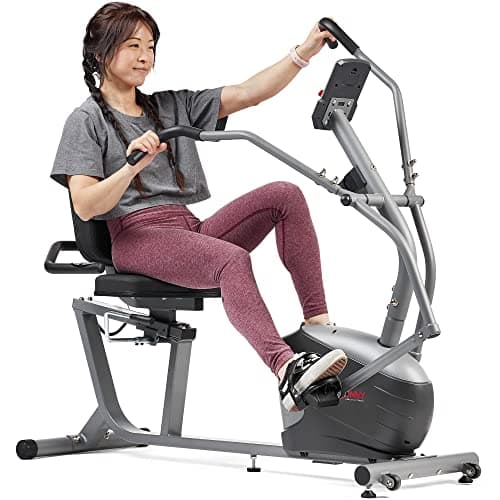
Top pick: Sunny Health & Fitness Smart Recumbent Bike with Dual-Motion Arm Exercisers