A Recumbent Bike Workout Plan for Seniors
A four-week plan that starts shorter than feels worthwhile and builds to the CDC's weekly target, with the seat setting that decides whether it helps or hurts.
Read the guideSeated and back-supported does not mean easy. What decides whether a recumbent bike is a real workout or a gentle warm-up is the resistance and the effort you put in — not the fact that you are sitting down.
The short answer
Yes — if you use the resistance and put in real effort. Seated and back-supported does not mean easy; the seat is a comfort feature, not a difficulty setting. Judge your effort with the talk test, and remember a bike is leg-focused aerobic work, so pair it with strength and balance.
“It is just sitting down” is the most common reason people underrate the recumbent bike, and it is a misunderstanding worth clearing up before you decide whether one belongs in your routine. The seat and the backrest are there to make the exercise comfortable and accessible — to take strain off your back, your knees, and your sense of balance so that you can keep going. They are not there to make the exercise easy. Whether a recumbent bike is a good workout comes down to one thing you control: how much resistance you dial in and how hard you push against it. Get that right and it is a genuine aerobic workout. Get on and coast, and it is a gentle spin. The machine does not decide — you do.
A recumbent bike is a good workout when you treat the resistance as the workout. That is the whole idea. On any decent bike you can turn the pedaling effort up until your legs are working hard enough that you notice it, until your breathing lifts and you feel warm within a few minutes. At that setting, held for twenty or thirty minutes, you are doing real cardiovascular exercise — the same kind of sustained aerobic work you would get from a brisk walk or a session on an upright bike, just without the impact and without the strain on your back or balance. The seated position changes how the exercise feels, not how much work it can be.
The mistake is to read the comfort of the position as a signal that the exercise is easy. Comfort and effort are two different dials. You can be perfectly comfortable — well-supported, no sore back, no wobble — and still be working hard, because the effort comes from your legs pushing against the resistance, not from having to hold yourself up. That is exactly what makes the recumbent bike so useful for older adults and joint-conscious exercisers: it strips away the discomfort that ends a lot of workouts early while leaving the actual training intact. So yes, it is a good workout — on the honest condition that you use the resistance rather than coasting on the lowest setting.
You do not need a heart-rate monitor or a fancy display to know whether you are getting a real workout. The simplest tool is one you already carry: your own breath. The CDC’s talk test is the honest way to judge moderate intensity — at a moderate effort you should be able to talk but not sing. If you can carry on a conversation but could not comfortably hold a tune, you are in the right zone. If you can sing along to the radio without any trouble, the resistance is too low and you are coasting; turn it up. If you cannot string a sentence together, you have pushed past moderate and should ease back.
This matters because the display on the bike can flatter or mislead you. The talk test cuts through all of that by measuring the one thing that counts, which is how hard your body is actually working. Use it as your minute-to-minute guide and let the numbers on the console be secondary. If you would like a fuller picture of how effort maps to intensity zones, our guide to heart rate zones for walking explains the same idea in more detail, and it carries over cleanly to the bike. The principle is identical: moderate effort you can sustain, judged by how you feel and breathe, is the target.
Where the recumbent bike really earns its place is sustainable aerobic training. It is the machine you can actually keep coming back to, because the things that usually cut a workout short — a sore back, an aching upright-bike saddle, the fear of losing your balance — are designed out of it. That comfort is not a weakness; it is the reason the exercise sticks. The best workout is the one you will still be doing in six months, and for a lot of older adults the recumbent bike is that machine precisely because there is no discomfort standing between them and the effort.
It is also genuinely kind to the joints. The pedaling motion is smooth and continuous, with none of the repeated impact that walking or jogging puts through your knees, hips, and ankles. The Arthritis Foundation notes that cycling’s continuous motion moves the joint through its range and helps lubricate it — which is part of why so many people with cranky knees find they can pedal comfortably even on days when other exercise is off the table. That gentleness is what lets some people push a knee that a treadmill would jar, getting a real cardio effort without paying for it afterward. If bad knees are your main concern, our roundup of the best recumbent bikes for bad knees looks at the features that matter most for joint comfort. The bike will not fix a damaged joint, but for keeping a stiff or arthritic one moving without pain, it is one of the best tools there is.
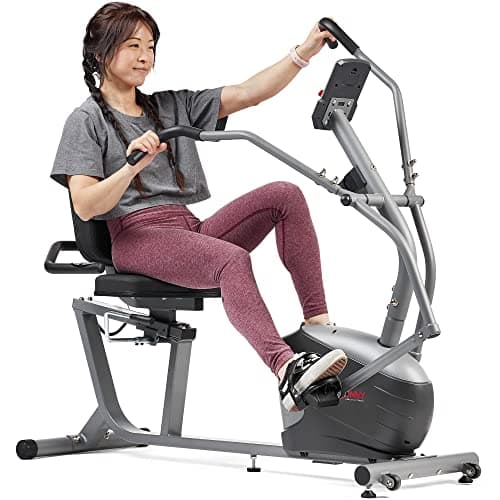
Here is the part a lot of enthusiastic reviews skip. A recumbent bike is leg-focused aerobic work, and that is nearly the whole of what it does. It builds cardiovascular fitness and it works your legs, and those are real, valuable things — but it is not a full-body workout, and it would be dishonest to sell it as one. A standard recumbent bike does little to nothing for your upper body, because your arms are along for the ride unless you have a dual-function model with moving handles. It is not weight-bearing, so it does not load your bones the way walking or standing exercise does, which means it is not the tool to lean on for bone health. And because you are seated and fully supported the entire time, it does nothing to train your balance.
None of that makes the bike a bad choice. It makes it one piece of a rounded routine rather than the whole thing. The CDC recommends that adults 65 and over get at least 150 minutes a week of moderate-intensity activity, plus two days of muscle-strengthening and balance activities. Read that carefully: the aerobic minutes are exactly what the recumbent bike is built to deliver, but the strength and balance work sits outside what any bike can do. So the honest recommendation is to use the bike for your cardio and cover the rest with something else — some resistance training for strength, and dedicated balance work so you keep the steadiness that a seated machine never challenges. The bike is a strong foundation. It is not the whole house.
If you have decided the bike is genuinely too easy for you, the fix is not to abandon it — it is to ask more of it. The most effective lever is resistance. Add a little more than feels automatic, hold it until it becomes your new normal, then add a little again. Progress that is slow and steady is progress you can keep. A second lever is intervals: after you are warm, alternate a few minutes at a harder effort with a few minutes easier, then repeat. Those harder stretches lift the overall demand of the session without asking you to grind at a high effort the whole way through, which is more sustainable and, for most people, more enjoyable.
The third lever is simply time — longer sessions, or more of them across the week, building toward that CDC target of at least 150 minutes of moderate activity. You do not have to arrive there overnight; you have to head in that direction. Add five minutes here, an extra ride there, and let the weekly total climb as your fitness does. For a structured way to put resistance, intervals, and session length together into a sensible week, our recumbent bike workout plan for seniors lays out gentle sessions that progress at a comfortable pace. And if your specific goal is fat loss, it is worth reading our honest take on whether recumbent bikes help you lose weight before you pin your hopes on the machine alone, because the answer there involves more than the pedaling.
For all the talk of pushing the resistance, there are days and situations when an easy spin at the lowest setting is not a failure to work hard — it is exactly the right thing to do, and a good thing. On a recovery day between harder sessions, gentle pedaling keeps you moving and loosens stiff joints without adding to your fatigue. If you are just returning to exercise after an illness, an injury, or a long break, starting easy is how you come back safely rather than scaring yourself off in the first week. And if you are very deconditioned — if any movement is a real effort right now — then a few gentle minutes on the recumbent bike is a genuine, worthwhile workout for where you are today, no matter what the resistance dial says.
The recumbent bike is uniquely good at meeting you at whatever level you are on, which is a large part of why it suits older adults and anyone easing back into fitness. The point is to match the effort to the day and the person, not to prove something to a machine. Some days that means real resistance and a talk-test moderate effort; other days it means a comfortable spin that keeps the habit alive and the joints moving. Both are the bike doing its job. And any time a joint is painful, or you are working around a medical condition or a recent injury, the sensible move is to talk to your doctor or physical therapist about what effort is right for you — their guidance outranks any general advice here.
So, is a recumbent bike a good workout? Yes — a genuinely good one for aerobic fitness and joint-gentle exercise, as long as you use the resistance and judge your effort honestly by the talk test rather than by the comfort of the seat. Be clear-eyed about what it is not: leg-focused cardio that does nothing for your upper body, your bones, or your balance, so it belongs alongside some strength and balance work, not in place of it. Within those limits it is one of the most sustainable ways an older or joint-conscious exerciser can get real cardiovascular training. If that sounds like the piece your routine has been missing, the best recumbent bikes for seniors is the place to start.
General information, not medical advice. Tread & Tone is written by an enthusiast, not a clinician. Nobody here is a doctor, a physical therapist or a trainer, and nothing on this site has been medically reviewed. Talk to your doctor or physical therapist before starting something new, particularly after surgery, a fall, or a change in medication.
It can be either, and that is the honest answer — you decide which by how much resistance you use and how hard you pedal. Sitting down does not make the exercise easy any more than it makes it hard; the seat is a comfort feature, not a difficulty setting. Turn the resistance up until pedaling takes real effort and hold it there, and a recumbent bike is a genuine aerobic workout. Spin at the lowest level with your feet barely pushing and it is a pleasant warm-up. Same machine, very different sessions.
Use the talk test rather than guessing. At a moderate effort you should be able to talk but not comfortably sing — if you can belt out a tune, turn the resistance up; if you cannot get a sentence out, ease off. It is a simple, free way to judge intensity that works for almost everyone, and it matters more than any number on the display. The goal is an effort you can sustain for a real stretch of time while still feeling like you are working.
No, and it is worth being honest about that. A standard recumbent bike is leg-focused aerobic work. It does little for your upper body unless it is a dual-function model with moving arm handles, it is not weight-bearing so it does not load your bones the way walking does, and it does nothing for balance because you are seated and supported the whole time. That is not a knock on the bike — it is simply one piece of a rounded routine, best paired with some strength and balance work.
A recumbent bike burns calories like any aerobic exercise, and steady sessions at a real effort contribute to the energy balance that weight loss depends on. But no single machine is a weight-loss button, and what and how much you eat matters at least as much as the pedaling. We have written a fuller, honest look at this in a separate guide rather than overpromising here. Treat the bike as a sustainable way to move regularly, which is the part most people actually struggle to keep up.
For many people with cranky knees it is one of the gentlest ways to get real aerobic exercise, because the motion is smooth and continuous with no jarring impact, and the reclined position takes pressure off compared with an upright bike. That lets some people push a knee that a treadmill would aggravate. It is not a cure and it is not right for every knee problem, so if a joint is painful or you are recovering from an injury or surgery, clear it with your doctor or physical therapist first.
Aim to build toward the CDC guideline of at least 150 minutes of moderate activity a week — that could be five sessions of 30 minutes, or shorter rides more often, whatever fits your week. Consistency beats intensity here; three or four steady rides every week will do far more over months than the occasional hard effort. Start with whatever you can manage comfortably, then add a few minutes or a bit more resistance as it gets easier, and let the weekly total climb gradually.
Product measurements are cited individually inside each Fit-to-You panel, against the manufacturer page or dated retailer listing they were read from.
A four-week plan that starts shorter than feels worthwhile and builds to the CDC's weekly target, with the seat setting that decides whether it helps or hurts.
Read the guideAn honest answer for older riders: what a seated bike can and cannot do for your weight, why the kitchen matters more than the console, and how to get the most out of the sessions you do.
Read the guideBest for Seniors
Eleven bikes ranked on the measurements that decide whether you can get on — with the count of specs each manufacturer refuses to publish.
Top pick: Sunny Health & Fitness Smart Recumbent Bike with Dual-Motion Arm Exercisers