Recumbent Bike vs Elliptical
One keeps both feet planted and supported; the other lifts and swings them through a stride. Which suits stiff knees, and which suits balance you don't fully trust.
Read the guideA rower trains more of your body than a bike ever will. It also asks you to get down to a low seat, hold a bar with both hands and round your lower back on every stroke — and for most people over 60, one of those three is the answer.
How this is funded: we earn a commission if you buy through our links, at no extra cost to you. It never changes what we recommend, and every page here names at least one thing we would not buy. Full disclosure.
The short answer
A rower trains more muscle, including your back and arms, and that is a real advantage. A recumbent bike wins on access: you step over a low frame onto a chair-height seat, your lower back is supported throughout, and no grip is needed. If getting down to a floor-level seat, holding a handle or loading your lower back is a problem, buy the bike.
This comparison is usually settled on calories per hour, which is the least useful number either machine produces. The questions that actually decide it are physical and specific: can you get onto it, can you hold onto it, and can your back take the stroke? Three honest yeses and a rower is a good machine. One no and it is the wrong purchase, regardless of how good the workout would have been.
One disclosure before we start. We do not rank rowing machines. This site covers recumbents, walking and balance equipment, and we have not measured a rower or collected published specs for one, so you will find no rower numbers on this page and no rower in our picks. What follows is about the movement— which is the part that decides this for an older body — plus the published figures for the bikes we do track.
A rowing seat sits a few inches off the floor. Getting on means lowering yourself most of the way to the ground under control, and getting off means standing up from there, usually while the handle is swinging somewhere behind you. That is a deep sit-to-stand, and it is one of the first movements people lose after 60 — the same movement that makes a low sofa or a low toilet seat a problem long before walking is.
A recumbent bike asks for something entirely different: a sideways step over a low frame, then sitting down onto a seat that is roughly chair height. That is why step-over height is the measurement this site cares about most, and why almost nobody publishes it. The seat heights we can cite run from the low twenties of inches upward, which is dining-chair territory.
Be honest with yourself about this one rather than optimistic. If you need a hand on something to get out of an armchair, a rower is a machine you will use twice. There is no technique that fixes it and no fitness level that removes it, because the problem is the height of the seat, not your conditioning.
Rowing is a chain: the legs drive, then the hips open, then the back and arms finish the pull. Done properly it is a powerful, efficient movement. Done for twenty minutes by somebody whose technique fades when they tire — which is everybody — it becomes repeated loaded flexion and extension of the lumbar spine, several hundred times per session.
That matters more after 60 than before it. MedlinePlus is clear that sciatica is a symptom of another problem rather than a condition on its own, and lists a herniated disk, spinal stenosis and piriformis syndrome among the causes. Loaded, repeated bending is the movement most people with disk trouble are told to treat carefully, which is a conversation for your physical therapist rather than for a product page.
There is a nuance worth stating, because we would rather be accurate than tidy. NIAMS notes that with lumbar stenosis, pain typically worsens with standing or walking and eases when leaning forward, because flexion opens up the spinal column. So a seated, slightly forward position is not automatically bad for every back — it is the repeated loaded flexion under resistance that is the concern, not sitting forward as such. Which is precisely why this belongs with the person who knows your imaging.
A recumbent bike sidesteps the question. Your lumbar spine rests against a padded backrest and stays there, and the only thing moving is your legs. That is the reason it is the machine most often recommended when the back is the constraint, and we have a whole page on what a recumbent bike does and does not do for back pain.
Every rowing stroke is a pull on one handle with both hands. That makes grip strength the ceiling on the entire workout: if your hands fail at eight minutes, the session is eight minutes long no matter how much your legs had left. Arthritic fingers, neuropathy and post-stroke weakness all show up here first.
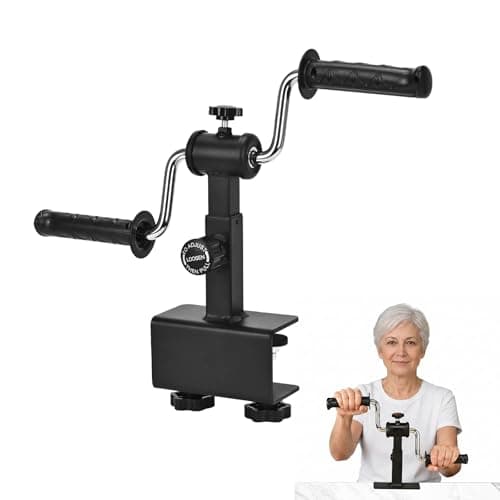
A recumbent bike requires no grip at all. There are handles, and they are for steadying yourself getting on and off, not for working against. If what you want is upper-body work and your grip is unreliable, a rower is the wrong purchase and so is anything else that asks you to hold a bar under load. The route that actually addresses it is a table-top arm exerciser— one of those publishes a pair of non-slip gloves in the box specifically for a weak grip, which is the only acknowledgement of the problem we found anywhere in the category.
This is the most common misconception in the comparison, and it cuts both ways. NIAMS describes bone as living tissue that responds to exercise by becoming stronger, and names weight-bearing exercise — activity that produces a force on bones that makes them work harder — as the kind that does it, giving brisk walking, stair climbing and dancing as examples.
You are sitting down on a rower and sitting down on a recumbent bike. Neither carries your body weight through your skeleton, so neither is the answer if bone density is why you are exercising. Choosing between them on bone grounds is choosing between two zeros. What you need is something upright added to whichever one you buy, and our page on recumbent bikes and osteoporosis says so in more detail.
Balance is the same story. Both machines seat you, back supported, for the entire session, and the CDC asks adults 65 and over for balance activities alongside the 150 weekly minutes and two days of strengthening. Neither of these contributes to that part of the target.
| What you care about | Recumbent bike | Rowing machine |
|---|---|---|
| Getting on and off | Sideways step over a low frame onto a chair-height seat. | Lower yourself to a seat a few inches off the floor, and stand back up from there. |
| Lower back | Supported against a padded backrest for the whole session. | Flexes and extends under load on every stroke, several hundred per session. |
| Grip needed | None. Handles are for steadying yourself, not for pulling. | Continuous. Grip strength is the ceiling on the whole workout. |
| Muscle covered | Legs, plus arms only on the models with moving handles. | Legs, back, shoulders and arms in one movement. Its real advantage. |
| Weight-bearing (bone) | No. You are seated. | No. You are also seated. |
| Balance trained | None, and none required. | None, and none required. |
| Technique risk | Low. Set the seat, pedal. Little to do wrong. | Real. Form degrades as you tire, and the back takes the difference. |
| Published accessibility specs | Patchy, but step-over, seat height and capacity exist on some models. | Not covered on this site — we have not measured any rower. |
We are not here to talk you out of a machine that suits you. Buy the rower if you can get down to that seat and back up without help, your lower back has no history that a therapist would want to know about, your grip is solid, and you want your upper body trained. In that situation it covers more ground than a bike does, and it covers some of the muscle-strengthening side of the weekly target as well as the aerobic minutes.
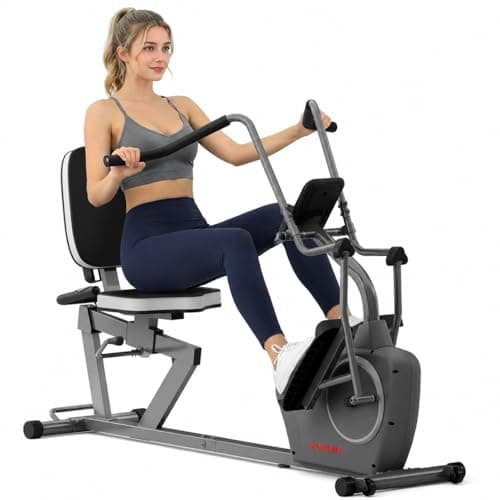
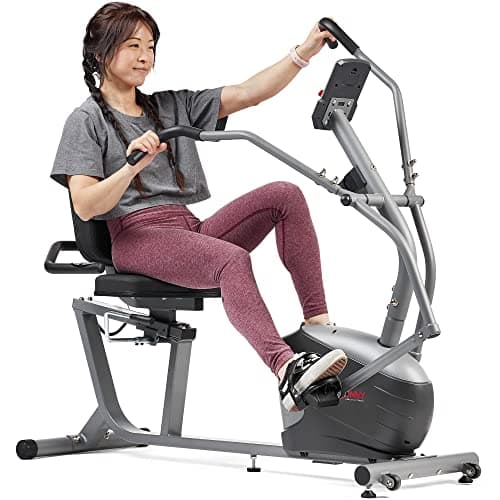
Buy the recumbent bike if any one of those four is shaky. And note what the bike gives up — the upper body — is partly recoverable: the bikes with arm exercisers move your arms while you pedal, and exactly one of those publishes handles that move independently of the pedals, which is the version that actually lets your arms work at their own pace.
The Arthritis Foundation points out that cycling’s continuous motion moves the joint through its range, which is the part that helps a stiff knee, and the National Institute on Aging lists riding a bike among the moderate-intensity activities that are safe for most people when built up slowly. That is a quieter recommendation than a rower’s full-body pitch, and it is the one that is still happening in March.
| Machine | Step-over height | Seat height from floor | Weight capacity | Footprint |
|---|---|---|---|---|
| Sunny Health & Fitness Smart Recumbent Bike with Dual-Motion Arm Exercisers | Not published by the manufacturer | 20.9 in minimum, 22.4 in maximum | 265 lb | 63.8 in long × 26.4 in wide × 49.6 in high |
| Teeter FreeStep Recumbent Cross Trainer | Not published by the manufacturer | Not published by the manufacturer | 350 lb; rated for users 4 ft 11 in to 6 ft 6 in | 59 in long × 32.7 in wide × 54.8 in high |
| Horizon Fitness 5.0 R Recumbent Bike | Not published by the manufacturer | Not published by the manufacturer | 300 lb per Horizon's own specification. The Amazon listing claims 350 lb — the two disagree | 66 in long × 25.2 in wide × 52.2 in high |
Capacity. Rowers and bikes both publish a user weight rating, and the rated figure is easier to find on a bike than on a walking machine. Two of the recumbents we track publish 450 pounds, which is well above anything in the walking category — and if you are shopping near the top of a machine’s range, our high-capacity recumbent shortlist and the high-capacity walking shortlist both rank on the published number rather than on the marketing.
And if what you actually wanted from a rower was the arm work rather than the rowing, read the arm page before you spend rower money. A table-top unit costs a fraction of a machine, needs no floor transfer and no grip strength you do not have, and it sits on the table where it will actually get used.
General information, not medical advice. Tread & Tone is written by an enthusiast, not a clinician. Nobody here is a doctor, a physical therapist or a trainer, and nothing on this site has been medically reviewed. Talk to your doctor or physical therapist before starting something new, particularly after surgery, a fall, or a change in medication.
For some, genuinely yes — it is one of the few machines that trains legs, back and arms in one movement, and it is non-impact. The three things that rule it out are specific rather than vague: you have to lower yourself onto a seat only a few inches off the floor and get back up afterwards, you have to grip and pull a handle with both hands, and the stroke repeatedly loads your lower back. If any one of those three is a problem, a recumbent bike does the cardiovascular half without them.
The bike, in almost every case. A recumbent bike supports your lower back against a padded seat back for the whole session, while a rowing stroke moves the lumbar spine through flexion and extension against resistance several hundred times. MedlinePlus notes that sciatica is a symptom of another problem — a herniated disk and spinal stenosis are among the causes — and loaded repeated flexion is exactly the movement people with disk trouble are usually told to be careful with. Ask your own physical therapist about rowing before buying one.
Neither one does. This is the mistake people make when choosing between them. NIAMS describes weight-bearing exercise as activity that produces a force on bones that makes them work harder, and names brisk walking, stair climbing and dancing. You are seated on both of these machines, so neither loads the skeleton the way standing activity does. If bone density is the goal, the answer is not a rower instead of a bike — it is adding something upright.
Yes, and that is its real advantage. A rowing stroke drives with the legs, then pulls with the back and arms, so it trains the upper body in a way pedaling cannot. If that is what you want and the floor transfer and the back load are not problems for you, a rower is a reasonable buy. If the floor transfer is the problem but you still want your arms involved, a recumbent cross trainer with moving handles gets you most of the way there from a seat with a backrest.
Much. A rowing seat sits a few inches above the floor, so getting on is a controlled descent and getting off is effectively a deep sit-to-stand from near floor level — which is one of the first movements to become difficult after 60, and the one people with knee or hip arthritis most often cannot do unaided. A recumbent bike is a sideways step over a low frame onto a chair-height seat. That difference is the whole decision for a lot of readers, and it has nothing to do with fitness.
Then a rower is out, and not by a small margin. Every rowing stroke is a pull on a single handle, so grip strength is the limiting factor for the entire workout — the legs can be willing and the session still ends when the hands give up. A recumbent bike needs no grip at all; your hands rest wherever is comfortable. If you want upper-body work with a weak grip, a table-top arm exerciser with grip gloves is a far better route than a rower.
Yes, exactly as you can count cycling. The CDC asks adults 65 and over for 150 minutes a week of moderate-intensity activity, two days of muscle strengthening and some balance work, and it does not specify equipment. Rowing has the advantage of covering some of the strengthening side as well as the aerobic minutes. Neither machine does anything for balance, because you are sitting down on both.
Product measurements are cited individually inside each Fit-to-You panel, against the manufacturer page or dated retailer listing they were read from.
One keeps both feet planted and supported; the other lifts and swings them through a stride. Which suits stiff knees, and which suits balance you don't fully trust.
Read the guideBack support, step-over height, and the wrist and shoulder load nobody mentions. Which one suits which body.
Read the guideBest Cross-Trainer
Seated ellipticals that swap the circular pedal stroke for a stepping stride — ranked on which makers publish a weight capacity and which hide it.
Top pick: VANSWE Recumbent Elliptical Cross Trainer
Best Arms and Legs
Only one machine here publishes arm handles that move independently of the pedals — which is the difference between an arms-only session on a bad-knee day and no session at all.
Top pick: Sunny Health & Fitness Smart Recumbent Bike with Dual-Motion Arm Exercisers
Why the back rest is the reason people ask, what it does and doesn't support, and when to ask someone qualified first.
Read the guideBest Arm Exerciser
An arm bike that slides across the table is an arm bike nobody uses twice. Seven ranked on what holds the unit still, whether a motor turns the cranks, and whether one arm can work without the other.
Top pick: KEAJVXT Arm Bike with Desktop Clamp
Price as of October 11, 2026. #ad How we’re funded