Tread & Tone

MERACH UltraWalk W60 Review

Two numbers on this listing exist almost nowhere else in the category: a sustained weight capacity alongside the peak one, and a continuous motor rating alongside the peak horsepower. Those two pieces of candor are the reason to look at the W60 — and the thing it has none of is the reason many readers here should not buy it.

By Stephen V.Last updated How we choose

How this is funded: we earn a commission if you buy through our links, at no extra cost to you. It never changes what we recommend, and every page here names at least one thing we would not buy. Full disclosure.

MERACH UltraWalk W60 Walking Pad

Publishes a sustained capacity

The only walking machine on this site that publishes two capacity figures instead of one: 400 lb peak and 330 lb sustained. The sustained figure is the one that matters, because it is the one you stand on for twenty minutes a day, and MERACH is alone here in telling you which number is which. It also has nothing at all to hold onto, which rules it out if balance rather than capacity is your reason for shopping.

MERACH does not publish 3 of the 10 measurements we look for. The panel below names which.

$349.99 · Check price on Amazon

Price as of November 12, 2026. #ad How we’re funded

Almost every walking pad sold today publishes one capacity figure and one motor figure, and both of them are the flattering version. The MERACH UltraWalk W60 publishes two of each, and the second number in both pairs is the one that tells you what the machine will actually do on a Tuesday morning in March.

Capacity first: 400 lb peak and 330 lb sustained, both published. No other walking machine we track separates those. “Max 400 lb” is the figure that goes in the listing title across this whole category, and nothing on a typical listing tells you whether that is a number the frame will survive once or a number you can stand on for forty minutes a day for a year. MERACH tells you: the second figure, 330 lb, is the one to check your own weight against.

Then the motor: 1.25 CHP continuous against 3.5 HP peak.Continuous horsepower is the rating a treadmill motor can hold indefinitely; peak is what it can produce for a moment. Most pads in this category publish only the peak, and the peak is typically two to three times the continuous figure — which is why a “3.5 HP” pad can feel strained under a heavier walker after twenty minutes. On the machines we have specs for, the W60 is the only one that states the continuous number at all.

And then the thing it does not have: anything to hold.No handrail, no handlebar, no upright of any kind. For a large share of the people this site is written for, that single fact ends the conversation regardless of how good the published numbers are — and it is the first thing we say rather than the last. We have not walked on this machine and we own none of the equipment we write about, so everything below is reasoned from what MERACH and the retailer listing publish. What we did instead is written down.

Fit-to-You: the nine measurements

MERACH does not publish 3 of 10 of these. Where that is the case, this panel says so rather than guessing. How we compile these

Step-up heightHow high you have to lift your foot to get onto the deck, every single time.
Not published by the manufacturer
HandrailsThe difference between a treadmill a nervous walker will use and one they won't.
None. There is nothing to hold

Source: Amazon product listing data (Creators API) · read 2026-10-10

Weight capacitySearched directly, and two of the senior-focused competitors omit it entirely.
400 lb peak and 330 lb sustained — the only machine on this site publishing both figures

Source: Amazon product listing data (Creators API) · read 2026-10-10

Minimum speedThe slowest the belt will go. A machine that starts at 1 mph is unusable if your walking pace is slower than that.
Not published by the manufacturer
Belt sizeA short belt means a shortened stride and a real risk of stepping off the back.
41.3 in long × 16.5 in wide; stated as 33 percent more stride space

Source: Amazon product listing data (Creators API) · read 2026-10-10

Display character heightCharacter height and contrast. Presbyopia is close to universal past 60.
Not published by the manufacturer
Controls and reachCan it be operated one-handed, by feel, while seated? This is where low-strength and low-vision buyers get stranded.
Remote with a magnetic dock on the deck, plus app control syncing to Apple Health and Google Fit; 12-level auto incline; child lock; pause memory

Source: Amazon product listing data (Creators API) · read 2026-10-10

Assembly and box weightBox weight and how many people it needs. A 130 lb box is a real barrier, not a footnote.
67.7 lb machine weight published; no box weight and no assembly steps stated

Source: Amazon product listing data (Creators API) · read 2026-10-10

Noise (dB)Apartments, shared walls, and a sleeping partner in the next room.
Stated as around 54 dB average by the seller, with no test method published

Source: Amazon product listing data (Creators API) · read 2026-10-10

FootprintWhether it actually fits the room you have in mind, with clearance to get on and off.
51.4 in long × 22 in wide × 6.5 in high; wheels fitted, stored flat or upright

Source: Amazon product listing data (Creators API) · read 2026-10-10

We have not used this machine. Everything above comes from the manufacturer’s published documentation and the dated retailer listing, with the source given for each figure. Where they don’t publish a number, we say so. We can’t tell you how it feels to ride, how quiet it really is, or how it holds up after two years — and anyone who tells you otherwise without owning one is guessing.

Why a sustained rating is worth more than a peak one

A weight capacity on a walking pad is doing two jobs at once, and manufacturers almost always publish only the easier one.

The peak figure is a structural claim.It is about the frame, the deck and the rollers not deforming under load. A machine can honestly claim 400 lb in that sense and still be the wrong machine for a 320 lb walker who intends to use it every day, because walking is not static loading — each step is an impact, and the motor has to accelerate the belt back up against it thousands of times per session.

The sustained figure is a duty-cycle claim, and it is the one the buyer actually needs. MERACH’s published 330 lb sustained rating is a statement about repeated, prolonged use rather than about survival, and it sits 70 lb below the headline number. If you weigh 350 lb, a listing that says “Max 400 lb” and nothing else has told you a true thing that is not the thing you asked. This one has told you both.

The same split runs through the motor rating. The CDC asks adults 65 and over for at least 150 minutes a week of moderate-intensity activity, and the NIDDK puts 300 minutes a week as the target for preventing weight regain. Either of those is five or six sessions a week, every week — which is a duty cycle, not a peak. A 1.25 CHP continuous rating is a modest number in absolute terms, but it is a published modest number, and we would take it over an unpublished 3.5 HP peak every time. For a fuller version of this argument across the category, see our shortlist of walking pads for weight loss, which is ranked on exactly this axis.

The largest walking surface here, and the tallest step onto it

The W60 publishes a 41.3 in by 16.5 in belt, which is the longest and the widest walking surface of any pad we track. Both dimensions matter for different reasons, and both matter more past 60 than they do at 30.

Length is stride and margin behind you.A short belt shortens your natural stride, and worse, it puts the back edge of the deck closer than you think it is. People drift backward when they stop paying attention, and a longer belt buys time before the drift matters. MERACH states the deck gives 33 percent more stride space, which is a comparative marketing claim rather than a measurement — but the 41.3 in itself is a measurement, and it is the largest number in the category.

Width is how much room you have to be imprecise. A 16.5 in belt gives you a few inches either side of each foot. On a narrower deck, a slightly uneven gait or a glance at a phone puts a foot on the frame rail, which on a moving belt is its own hazard.

The cost of all that deck is height and weight.The W60 is 6.5 in tall, the highest-profile pad we track, and 67.7 lb, the heaviest. Neither figure is hidden — both are published — but together they mean two things. One: the step onto the deck is the biggest in the category, and MERACH does not publish a step-up height, so the figure that actually decides whether you can get on safely is unstated even here. Two: a 67.7 lb machine with transport wheels is something you reposition occasionally, not something you tidy away daily. If the pad has to live under a sofa between sessions, read our guide on how to choose a walking pad before committing to this one.
The incline is remote-operated, which is the right design

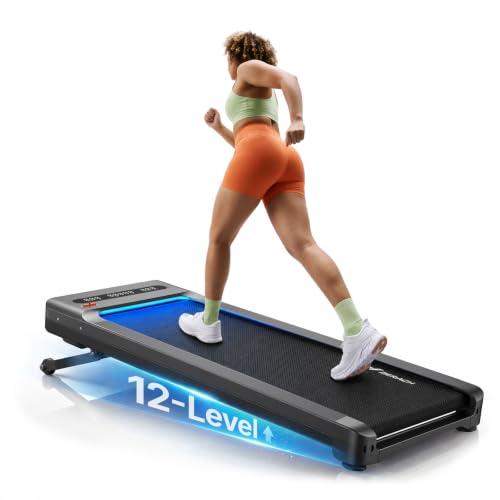
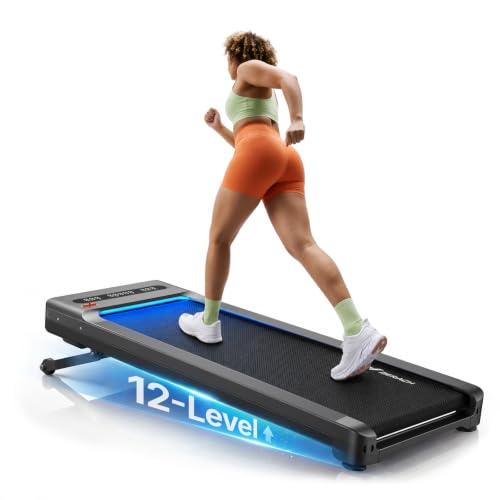
Twelve levels of auto incline, driven from a remote with a magnetic dock on the deck. The incline range itself is a fitness feature; the remote is an accessibility one, and it is the detail we would point to on this machine after the two honest numbers.

Manual incline on a walking pad usually means bending down to the deck and either turning a foot or swapping a spacer. That is a stoop, a reach and a change of balance, performed next to a machine you are about to stand on. An auto incline changed from a handheld remote removes the whole movement. The same remote handles speed, start and pause, so a session can be run without leaning toward the front of the deck at any point — which on a pad with nothing to hold is more important than it sounds, not less.

Incline is also the most useful intensity control on a walking machine. It raises the work your legs do without raising the speed, and speed is the variable that makes walkers nervous. A reader who wants to get their heart rate up without moving their feet faster has exactly one lever, and this machine gives them twelve settings of it. We go through the trade in what incline walking actually does.

The rest of the console is of its era: Bluetooth speaker, RGB lighting, an app that syncs to Apple Health and Google Fit, a child lock and a pause memory. The lock is genuinely useful in a house with grandchildren. The lighting is not a reason to buy anything.

What the listing will not tell you, and one of them is serious

For a listing this forthcoming about capacity and motor, the gaps are strange, and one of them is the single most important number for the reader of this site.

No speed range is published anywhere.Not a maximum, and — critically — not a minimum. The slowest the belt will go is the figure that decides whether a walking machine is usable for somebody whose comfortable pace is slower than a stroll, and on this machine it is simply absent. Several pads we track publish a 0.5 mph floor. If your pace is genuinely slow, a machine whose floor is unknown is a gamble, and we would ask the retailer outright before ordering. Our guide to what speed to set a walking pad to explains why that number does more work than the top speed.

No step-up height. The 6.5 in overall height is published, but overall height is not the same measurement as how high you lift your foot to clear the belt. This gap is near-universal in the category and it is the reason we wrote a whole page about the measurement.

The 54 dB figure has no test method attached.MERACH states it as an average; there is no microphone distance, no belt speed and no walker weight, so it is not comparable with the two other machines in the category that state a figure. Notably, MERACH’s number is the highestof those three, which we read as candor rather than as a defect — the reasoning is in our shortlist of quiet walking pads for apartments.

No display character height, and no box weight. The machine weight is published at 67.7 lb; what arrives at your door is heavier, and nobody states by how much. For an older buyer taking delivery alone, that is a real planning gap.

Who this suits

A heavier walker who wants a number they can rely on.The 330 lb sustained rating is the only figure of its kind in this category. If you are shopping in the upper half of the capacity band, it is worth more than anyone else’s 400.

Somebody planning long, daily sessions. A published continuous motor rating is a statement about duty cycle, and five or six sessions a week is a duty cycle. This is the machine in the category that answers that question honestly.

A walker who wants incline without bending down. Twelve auto levels from a remote, with speed and start on the same remote, so nothing needs a reach toward the front of the deck.

Anyone whose constraint is deck size. 41.3 in by 16.5 in is the largest walking surface we have specs for, and belt length is the quietest safety feature on a walking machine.

Who should skip it

Anyone who needs something to hold.This is the big one. There is no handrail, no handlebar and no upright. If you put a hand on the wall going downstairs, buy a machine with a rail instead — the Sunny Treadpad Pacer is a pad with a folding handlebar, and the machines with full-length rails are ranked on where the controls sit.

Anyone whose pace is very slow. No minimum speed is published for this machine at all. If 0.5 mph versus 1.0 mph is the difference between a usable machine and an ornament, do not buy on an unpublished figure.

Anyone who has to put it away every day. 67.7 lb and 6.5 in tall. It rolls, and it stores flat or upright, but it is the heaviest and tallest pad we track.

Anyone whose deciding number is the step onto the deck. It is not published, and on the tallest pad in the category that is the gap we would most like filled.

$349.99 · Check price on Amazon

Price as of November 12, 2026. #ad How we’re funded

General information, not medical advice. Tread & Tone is written by an enthusiast, not a clinician. Nobody here is a doctor, a physical therapist or a trainer, and nothing on this site has been medically reviewed. Talk to your doctor or physical therapist before starting something new, particularly after surgery, a fall, or a change in medication.

Questions people ask

What is the weight capacity of the MERACH UltraWalk W60?

MERACH publishes two figures, which is why this machine is worth a second look: 400 lb peak and 330 lb sustained. The 330 lb number is the one to check your own weight against, because it is a claim about repeated daily use rather than about what the frame survives once. No other walking machine we track separates the two, and on a typical listing only the peak figure appears.

How slow does the W60 belt go?

The listing does not say. That is the machine's most serious disclosure gap for this site's readers, because the minimum speed — not the maximum — decides whether a walking pad is usable for somebody whose comfortable pace is slower than a stroll. Several pads we track publish a 0.5 mph floor; the W60 publishes no speed range at all. If your pace is genuinely slow, ask the retailer before you order rather than assuming.

Does the MERACH UltraWalk W60 have handles?

No. There is no handrail, no handlebar and no upright of any kind, and that is the single biggest reason a reader of this site might rule it out no matter how good its published numbers are. If you want something to hold, look at a pad with a folding handlebar such as the Sunny Treadpad Pacer, or at a walking treadmill with full-length rails on both sides.

What does the 1.25 CHP motor rating mean?

Continuous horsepower is the output a treadmill motor can hold indefinitely, as opposed to peak horsepower, which is what it can produce for a moment. The W60 publishes both: 1.25 CHP continuous and 3.5 HP peak. Most pads in this category publish only the peak, which is typically two to three times the continuous figure. 1.25 CHP is a modest rating in absolute terms, but it is a published one, and for daily hour-long walks the continuous number is the honest guide.

How big is the walking belt?

41.3 in long by 16.5 in wide, published — the largest walking surface of any pad we track. Length matters because a short belt shortens your stride and puts the back edge of the deck closer than you think; width matters because it is the margin you have either side of each foot if your gait is slightly uneven. MERACH also claims 33 percent more stride space than its own earlier deck, which is a comparison rather than a measurement.

How loud is the MERACH UltraWalk W60?

MERACH states around 54 dB as an average, with no test method, microphone distance, belt speed or walker weight published. That makes it incomparable with the other two machines in this category that state a figure — and MERACH's is the highest of the three, which we read as candor rather than as evidence it is the noisiest. A decibel figure also says nothing about the structure-borne thump a downstairs neighbor hears, which is the noise that actually causes arguments.

Is the W60 easy to move and store?

Less so than most pads. It publishes a 67.7 lb machine weight, the heaviest we track, and a 6.5 in height, the tallest. It has transport wheels and stores flat or upright, so repositioning it is possible — but this is a machine that lives where you put it rather than one you tidy away after every session. No box weight is published, so plan for the delivered weight to be higher.

Sources

Product measurements are cited individually inside each Fit-to-You panel, against the manufacturer page or dated retailer listing they were read from.

Read next

How to Choose a Walking Pad

A walking pad is not a small treadmill. Four numbers decide it — belt length, what there is to hold, the slowest speed and the weight you have to move — and most listings publish two of them.

Read the guide